Applying Motor Learning Principles in Youth Soccer Coaching

Motor learning connects the design of practice with lasting changes in skilled performance.
Introduction
Coaching youth soccer is both an art and a science. Sport knowledge and relationships matter, but so does the design of the learning environment. Motor learning is commonly defined as a relatively permanent change in the capability for skilled performance that develops through practice or experience (Magill & Anderson, 2017; Schmidt et al., 2019). That definition creates an important distinction: a player can look better during one drill without demonstrating durable learning. Retention and transfer, not practice fluency alone, are therefore the outcomes that matter most.
This article examines 12 motor learning principles and translates them into decisions a youth soccer coach or physical educator can make. Two textbooks provide the organizing foundation (Magill & Anderson, 2017; Schmidt et al., 2019), ecological texts on the constraints-led approach provide the practice-design perspective (Button et al., 2021; Renshaw et al., 2019), and peer-reviewed reviews and meta-analyses are used to update the strength, scope, and limitations of individual claims. The principles are not universal laws. Their effects depend on the learner, the task, the practice history, and the performance environment (Newell, 1986).
Performance is the behavior observed during practice. Learning is inferred from a relatively persistent capability, usually tested after a delay (retention) or under a changed task or context (transfer). The two can dissociate: conditions that make practice look smooth can produce weak learning, and conditions that create manageable errors can produce stronger learning (Kantak & Winstein, 2012; Soderstrom & Bjork, 2015). Throughout this article, claims about learning are interpreted most strongly when they are supported by retention or transfer tests.
Why Evidence Matters in Youth Soccer
Youth soccer coaching has long relied on tradition, imitation of other coaches, and intuition (Williams & Hodges, 2005). When researchers observed 25 youth soccer coaches across 70 sessions in England, players spent more time in “training form” activities, such as unopposed technique drills and fitness work, than in “playing form” activities, such as small-sided and conditioned games. Coaches also gave high levels of instruction and feedback regardless of the activity, and practice changed little across age and skill groups (Ford et al., 2010). None of these habits is wrong in every case. Each, however, is a practice-design decision that motor learning research can inform, and the principles below are meant to make those decisions deliberate rather than habitual.
How Each Principle Is Organized
Every principle follows the same structure so that the sections can be read, compared, and taught in the same way:
- The Concept: what the principle states and where it comes from.
- Section Objective: what a coach should be able to do after reading the section.
- Coaching Scenario: a youth soccer situation that exposes the problem the principle addresses.
- The Solution: how the principle changes the practice design in that scenario.
- Evidence and Boundaries: what the research supports, how strongly, and where the claim stops.
- Drills: a link to five practice tasks in the printable drill appendix (PDF), each with a setup diagram and built to accomplish the section objective (60 drills in total).
- How to Know It Worked: a retention or transfer check that separates learning from practice performance.
- Key Takeaways: the principle compressed into points a coach can carry onto the field.
The scenarios are illustrative composites based on common coaching situations, not case reports of specific teams.
Overview of the 12 Motor Learning Principles
The following table summarizes all 12 principles. Use it to identify a practice-design decision, not as a checklist that must be applied all at once.
| Principle | Practice-design question | Evidence note |
|---|---|---|
| 1. Encoding Specificity | Does practice preserve information that guides action in competition? | Foundational principle with laboratory support; operationalized in sport through representative design |
| 2. Practice Variability | When should conditions or skills be varied or interleaved? | Meta-analytic transfer benefit, but smaller in applied settings and negligible in younger learners |
| 3. Transfer of Learning | Which functional elements are shared with the target performance? | Foundational principle; transfer must be tested, not assumed |
| 4. Action-Effect | Can the cue direct attention to the intended movement effect? | Large literature, but bias-corrected re-analyses suggest the advantage is much smaller than first reported |
| 5. Augmented Feedback | What information can the learner not obtain intrinsically? | Heterogeneous evidence across gross and sport-specific skills |
| 6. Feedback Frequency | When should the coach speak, wait, summarize, or ask? | Strong theoretical basis; recent meta-analyses question the size of the reduced-frequency benefit |
| 7. Whole vs. Part | Will isolation preserve or disrupt essential coordination? | Textbook heuristic broadly supported by a meta-analysis, but based on few studies |
| 8. Distribution of Practice | Is fatigue or inattention reducing practice quality? | Robust spacing effect that shrinks as task complexity increases |
| 9. Stages of Learning | How automatic is this skill under these demands? | Classic descriptive model, not a fixed linear sequence |
| 10. Practice Like You Play | Are perception and action meaningfully coupled? | Representative-design framework; youth small-sided-game reviews are supportive but of modest quality |
| 11. Observational Learning | What should learners observe before they attempt? | Systematic-review support in physical education; cueing details remain mixed |
| 12. Optimal Challenge | Is functional difficulty productive for this learner? | Influential framework; requires ongoing individual calibration |
Principle #1: Encoding Specificity
Preserve the Information That Guides Action
The Concept
The encoding specificity principle comes from memory research: a retrieval cue is effective to the extent that the information it carries was encoded at the time of learning (Tulving & Thomson, 1973). Motor learning applies the same logic to movement. What is learned is shaped by the perceptual, cognitive, and movement demands present during practice, so performance at test is best when the test reinstates the conditions of practice (Magill & Anderson, 2017). Proteau’s specificity of practice work showed a striking version of this effect: learners who practiced an aiming task with vision of their limb became more dependent on that visual information with extended practice, and their accuracy declined when it was removed (Proteau, 1992).
For a soccer player, the practice “conditions” include more than the field and the ball. They include the information the player must pick up before acting: the pace and angle of the incoming pass, the position of the nearest defender, the goalkeeper’s starting point, and the time available. If practice removes that information, the player may learn a skill that depends on its absence. Exact replication of match day is neither possible nor always desirable. The design goal is to retain the information–movement relationships that matter (Pinder et al., 2011).
After this section, a coach should be able to audit a drill for the information it preserves or removes, and rebuild a finishing task so that the player practices with the information that guides finishing in a match.
Coaching Scenario: The Shooting-Line Specialist
An under-11 coach opens every session with a shooting line. Players dribble to a cone, take a set touch, and strike at an empty goal or a passive goalkeeper. By midseason, most players finish cleanly in the drill. In matches, the same players snatch at chances: they shoot while a defender is closing, take an extra touch that lets the goalkeeper set, or pass when the goal is open.
The problem: the shooting line trained the striking action but removed the information that controls finishing. No defender closed space, the ball always arrived at the same speed, and the only option was to shoot. Players learned to strike a predictable ball, not to read the situation that determines when, where, and whether to shoot.
The Solution
The practical question is not “Does this look like a game?” but “Does the player have to use the same information to decide and act?” A useful way to audit a drill is to separate four elements of the performance and ask whether each survives in practice (Pinder et al., 2011):
| Element | Question to ask | Finishing drill that drops it | Finishing drill that keeps it |
|---|---|---|---|
| Information | What must the player see or hear before acting? | Shooting from a stationary ball with no one nearby | Receiving a moving pass while a defender closes space |
| Decision | Is there a choice to make? | Every repetition ends with the same shot to the same corner | The player chooses between shooting, dribbling, and passing |
| Action | Does the movement pattern match the demands of the game? | A perfectly weighted pass that arrives in the same spot every time | Passes with varying speed and angle that require adjusting the first touch |
| Consequence | Does the player experience the result? | Balls kicked into an empty net or a wall with no feedback on success | A goalkeeper and a visible target outcome (goal, save, miss) |
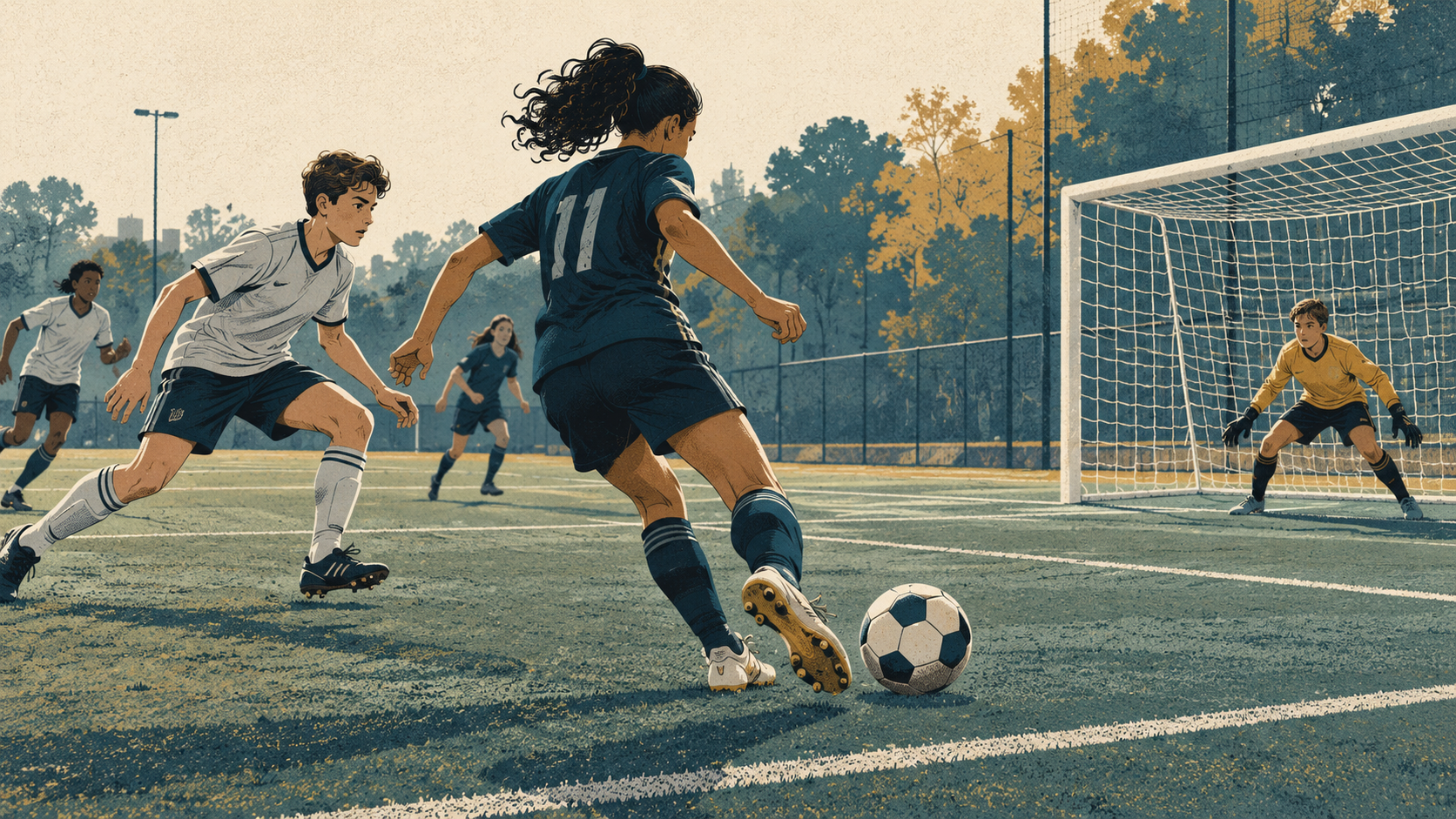
Applied to the scenario, the coach keeps the goal of the activity (finishing) and restores the missing elements in stages, so the task remains learnable:
- Establish the action. Start with a predictable ball so the player can find a workable striking pattern.
- Add the information source. Introduce a moving pass from different angles, then a passive defender whose position the player must read.
- Add the decision. Give two or three options (shoot, dribble, pass) and let the defender’s position determine the best one.
- Add the consequence and pressure. Include an active goalkeeper, a time limit, or a scoring condition so the outcome matters.
Move to the next stage when the player’s errors become informative rather than random, not on a fixed schedule. A drill does not need to keep all four elements at once; a novice may need a stable, low-information version first. An experienced player, however, gains little from a task that removes the defender, the decision, and the goalkeeper altogether.
Evidence and Boundaries
The specificity idea has strong laboratory support in memory and aiming research (Proteau, 1992; Tulving & Thomson, 1973), and it is a foundational principle in both major motor learning textbooks (Magill & Anderson, 2017; Schmidt et al., 2019). In sport, it is operationalized through representative learning design, which asks whether practice samples the information present in the performance environment (Pinder et al., 2011). Two cautions limit the principle:
- Higher fidelity is not automatically better. A task that imitates the match but exceeds the player’s current capacity can produce frustration and disorganized movement. Simplifying a task is acceptable when the information that controls the action is kept intact (see Principle #12).
- Similar appearance is weak evidence. A cone slalom and a defended dribble both involve ball control, but the slalom lacks the opponent whose movement determines when and where to change direction. Judge specificity by what the player must perceive and decide, not by whether the equipment matches.
Most specificity studies used laboratory tasks with adults; direct tests in youth soccer finishing are scarce. The principle is best treated as a well-grounded design hypothesis that the coach then tests.
Drills
Five drills for this principle (Drills 1A to 1E), each with a setup diagram, are in the drill appendix, page 2.
How to Know It Worked
Do not judge the change by goals scored in the drill. After about two weeks, test shot selection and shot quality in a small-sided scrimmage that was not used during practice. Tally, for each shooting chance, whether the player chose a defensible option (shoot when space and angle allow, pass when a teammate is better placed) and whether the shot was on target. Compare those tallies with a baseline scrimmage recorded before the change.
- What is learned is tied to the information present during practice.
- Audit drills for four elements: information, decision, action, and consequence.
- Restore missing elements in stages rather than jumping to full match conditions.
- Judge specificity by what the player must perceive and decide, not by how the drill looks.
- Test the change in a game form, not in the drill that produced it.
Principle #2: Practice Variability
Progress From Stability to Adaptability
The Concept
Practice variability has two related meanings. Variable practice changes the conditions of one skill, such as passing over different distances, angles, and speeds. Schema theory proposed that this variation helps the learner build a generalized rule linking movement parameters to outcomes, which supports performance in situations never practiced exactly (Schmidt, 1975). Contextual interference concerns the order in which several skills or variations are practiced. In blocked practice, the learner completes all repetitions of one task before moving to the next; in random or interleaved practice, the tasks are mixed.
Shea and Morgan’s classic study showed the counterintuitive pattern: random practice produced worse performance during acquisition but better retention and transfer than blocked practice (J. B. Shea & Morgan, 1979). Schmidt and Bjork described this as one example of a broader principle: conditions that make practice harder in the short term can benefit long-term learning (Bjork, 1994; Schmidt & Bjork, 1992).
After this section, a coach should be able to decide when a skill needs stable, blocked repetition and when it is ready for variation and interleaving, and to sequence a receiving task from stability to adaptability.
Coaching Scenario: The Ten-Repetition Station
An under-10 coach organizes practice in stations. At the receiving station, each player receives ten identical ground passes from a partner five meters away, then moves on. The drill runs smoothly and the coach notes that first touches have improved. On game day, the ball arrives bouncing, faster, from the side, or with a defender nearby, and the same players lose control of it.
The problem: the station produced one well-rehearsed solution for one set of conditions. The players improved at that pass, but they had little opportunity to adapt the touch to the range of balls a match delivers.
The Solution
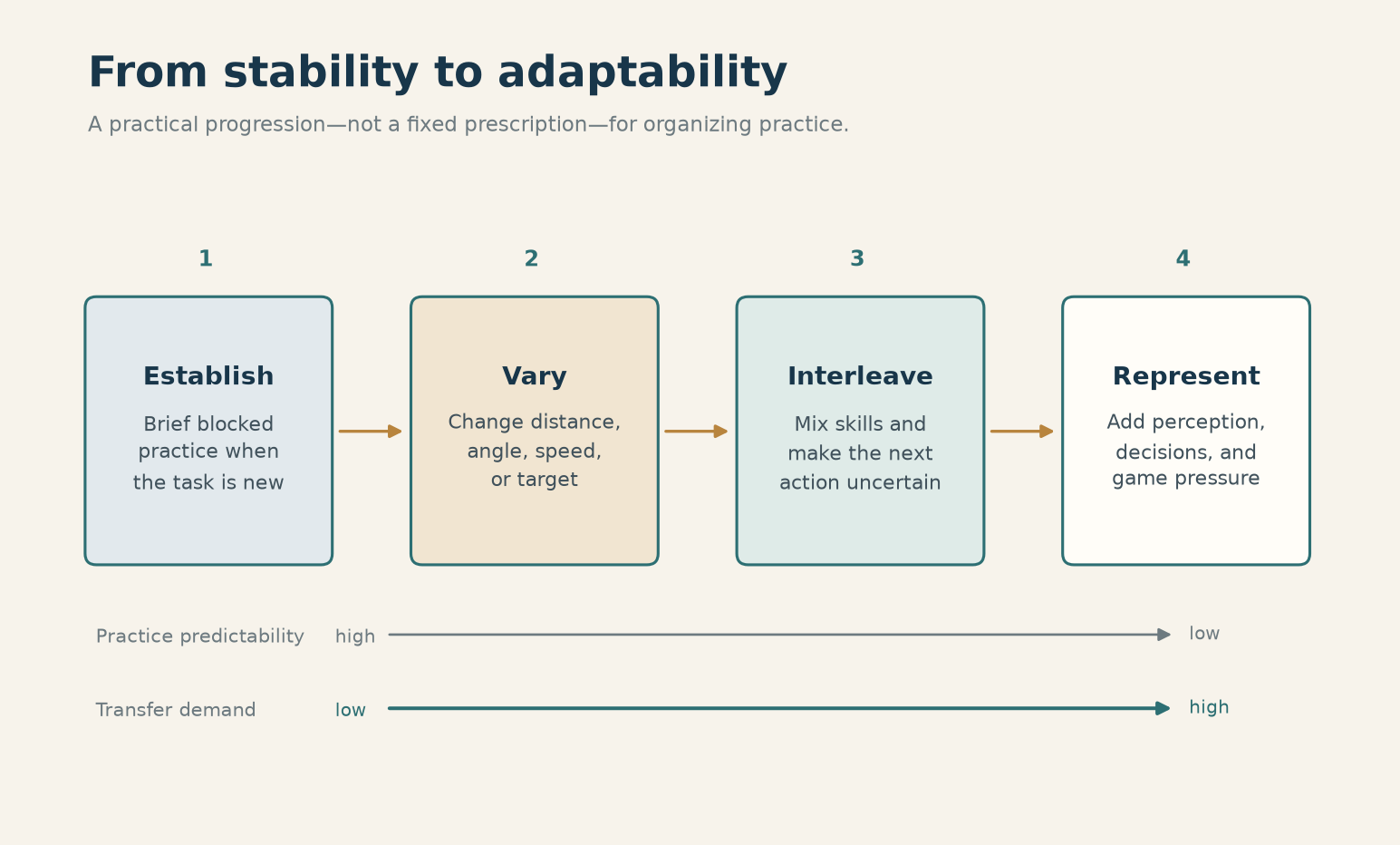
The coach keeps the skill (receiving) but progresses the conditions in four steps: establish, vary, interleave, represent.
| Practice Type | Description | Example | Learning Effect |
|---|---|---|---|
| Blocked Practice | Repetitive drilling of one skill or variation | Ten identical ground passes, then ten bouncing passes | Often smoother acquisition; useful when the action is new |
| Variable Practice | Changing the parameters of one skill | Ground passes from 5, 10, and 15 m at different speeds | Broadens the range of conditions the learner can handle |
| Random Practice | Mixing different skills or variations unpredictably | Ground, bouncing, and lofted passes in an order the receiver cannot predict | More contextual interference; may support retention or transfer when difficulty is appropriate |
In the scenario, players who cannot yet control a simple ground pass stay with a stable, blocked version. Once that touch is reliable, the coach varies distance, angle, receiving foot, and pace; then mixes pass types in an unpredictable order; and finally places the receiving task inside a game with a defender. Change only enough features to keep the learner solving the intended problem.
Evidence and Boundaries
The contextual interference effect is one of the most cited findings in motor learning, but its size depends on context. Brady’s meta-analysis reported a moderate retention and transfer benefit in laboratory studies and a much smaller one in applied settings (Brady, 2004). A 2024 meta-analysis focused on transfer found an overall benefit favoring random practice, but the effect was small and not statistically significant in applied settings and negligible in younger participants (Czyż et al., 2024). Textbook accounts note that the effect is more likely when the tasks being interleaved are controlled by different motor programs and when the learner has some experience with each task (Magill & Anderson, 2017).
For youth coaching, these findings argue against two extremes. Endless blocked repetition limits adaptability, but maximal randomness can overwhelm a beginner and add noise rather than useful difficulty. Variability should be progressed to match the learner, not maximized automatically.
Drills
Five drills for this principle (Drills 2A to 2E), each with a setup diagram, are in the drill appendix, page 5.
How to Know It Worked
Test after a delay of at least one day and use a condition that was not practiced, or one that was practiced less often. For example, measure first-touch control on serves from a new distance or angle, or in a 3v3 game. Count clean first touches out of ten. If the blocked-practice group (or the team’s earlier baseline) looks better during practice but no better, or worse, on the delayed test, the variation is doing its job.
- Variable practice broadens the conditions a skill can handle; random practice adds contextual interference.
- Random practice often looks worse during practice and better at retention or transfer.
- The benefit is smaller in applied settings and in younger learners, so progress variation rather than maximizing it.
- Establish a workable action first, then vary, interleave, and represent.
- Warn players that harder practice will feel less successful.
Principle #3: Transfer of Learning
Leverage Positive Transfer Between Skills
The Concept
Transfer of learning describes how practice on one task changes performance on another. Positive transfer helps the target performance, limited transfer produces little measurable change, and negative transfer interferes with it (Magill & Anderson, 2017). The oldest explanation, the identical elements theory, proposed that transfer depends on how many elements two tasks share (Thorndike & Woodworth, 1901). Contemporary accounts emphasize shared functional elements, such as the information used, the decisions required, and the coordination pattern, rather than surface features like equipment (Magill & Anderson, 2017; Schmidt et al., 2019).
Transfer can also be described by its distance. Near transfer occurs between very similar tasks and contexts; far transfer occurs across tasks, settings, or time frames that differ substantially, and it is much harder to obtain (Barnett & Ceci, 2002). A special case relevant to soccer is bilateral transfer: practice with one limb can improve performance with the other, which is one reason weak-foot practice is not wasted time even when progress is slow (Magill & Anderson, 2017).
After this section, a coach should be able to state the intended transfer before choosing a drill, identify drills likely to produce limited or negative transfer, and redesign them so they share functional elements with the game.
Coaching Scenario: The Agility-Ladder Dribbler
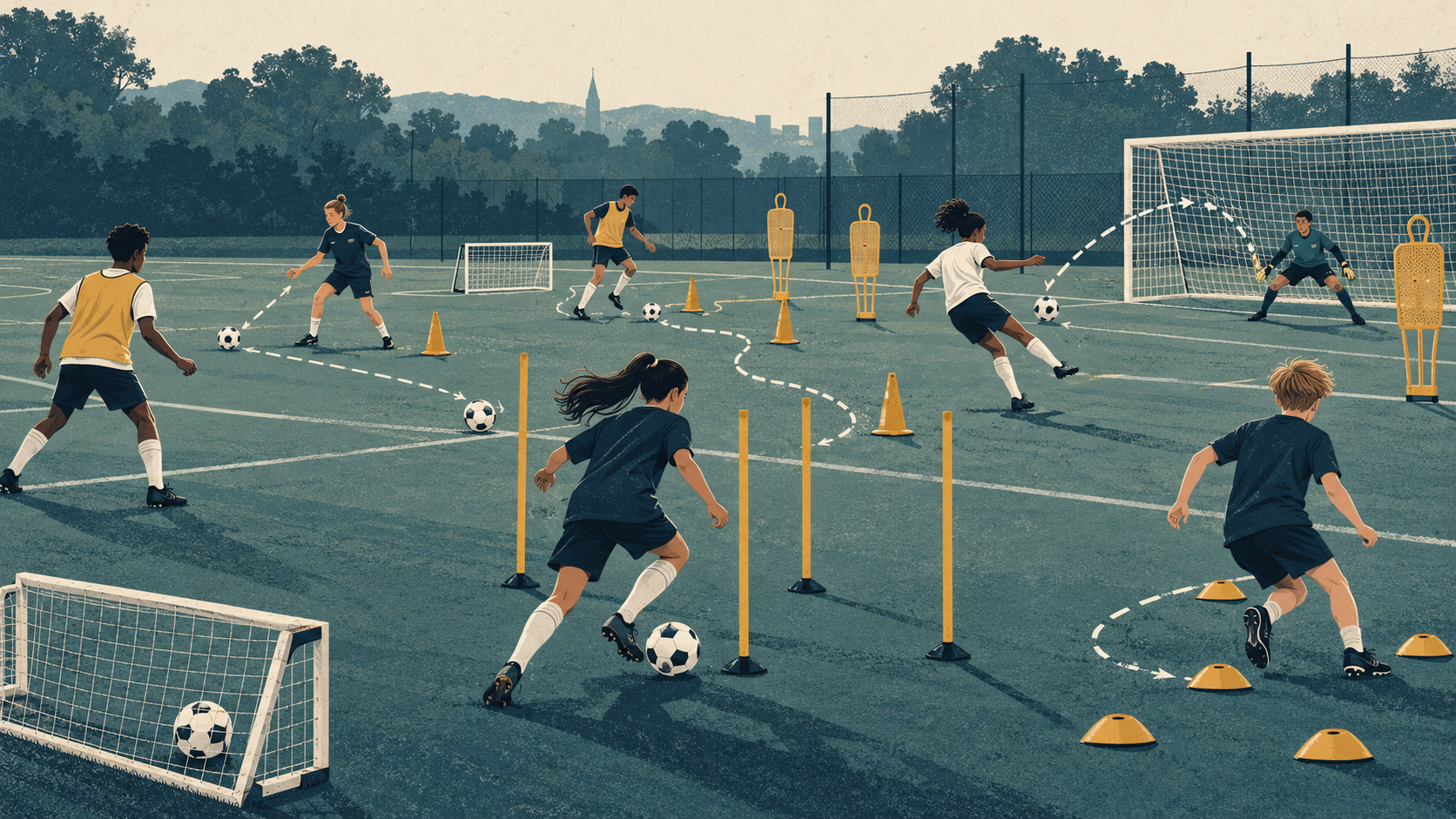
An under-12 coach wants players to beat defenders in 1v1 situations. Each session includes agility-ladder footwork and a cone slalom dribble. Players become noticeably faster through the ladder and the cones. In games, the number of successful 1v1 dribbles does not change. Some players even look worse: they dribble with their head down, as they do in the slalom, and run into defenders they never looked at.
The problem: the coach assumed transfer because the drills “involve feet and the ball.” But the ladder and slalom share few functional elements with a 1v1. Neither includes an opponent whose movement determines when to change direction, and the slalom rewards a head-down pattern that conflicts with what a 1v1 requires. The result is limited transfer at best and negative transfer at worst.
The Solution
The coach starts from the target performance and works backward. A 1v1 dribble requires reading the defender’s position and weight, changing speed and direction at the right moment, and protecting the ball. A transferable drill must include at least the defender’s cue and the timing decision. State the intended transfer before choosing the task: “This activity is designed to improve how the dribbler times a change of direction against a defender’s approach.”
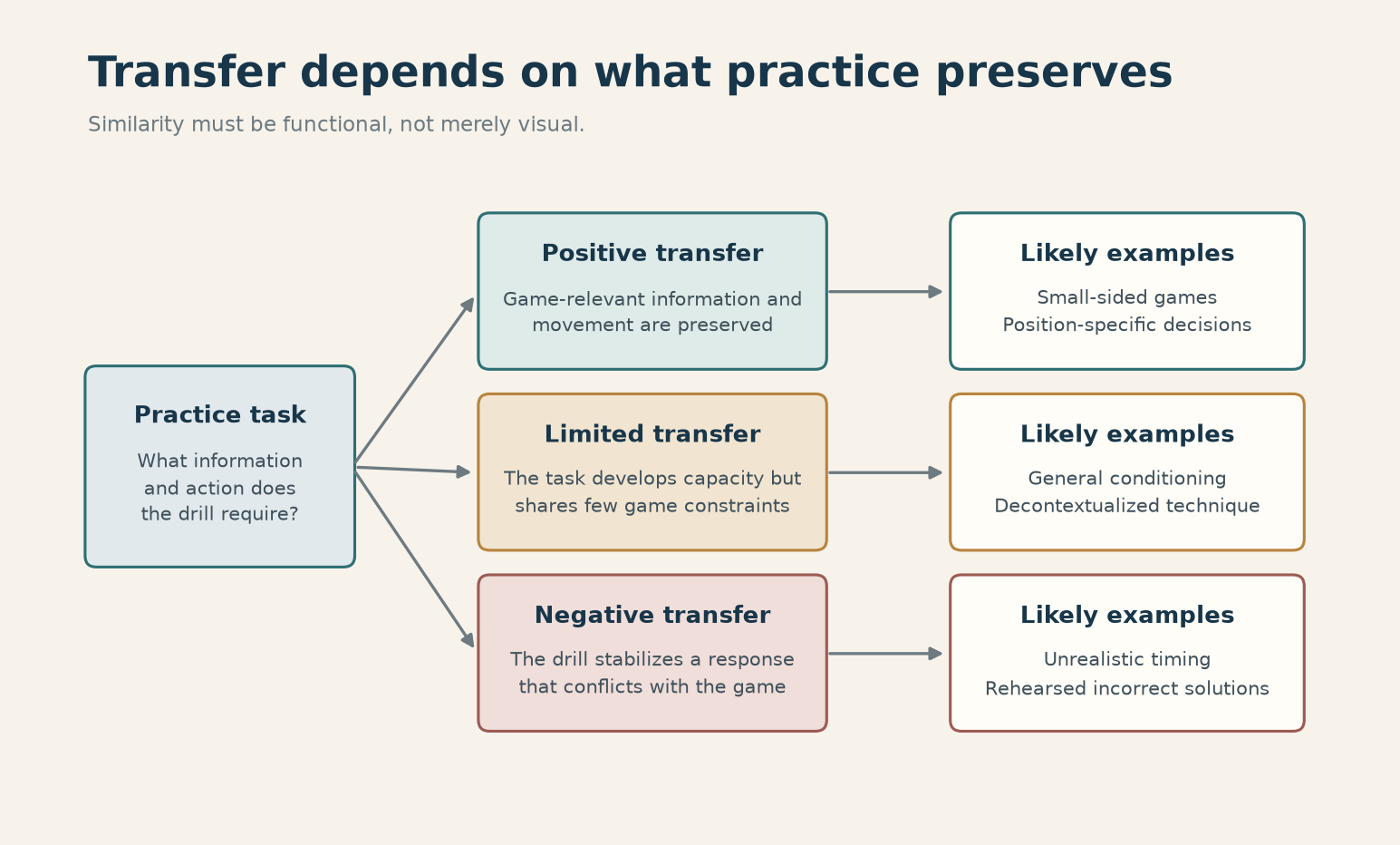
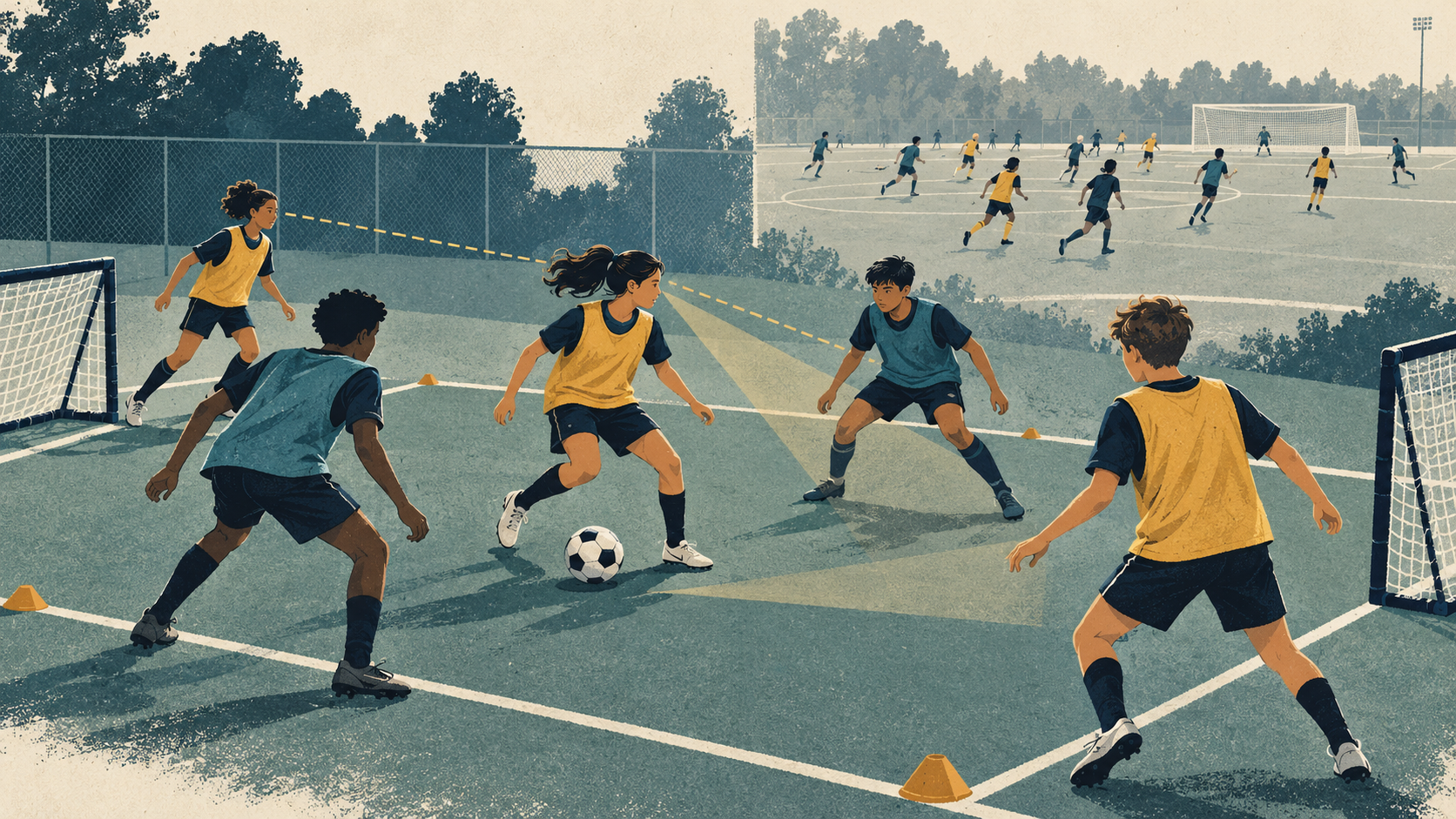
Transfer is more plausible when the practice task preserves decision–action relationships of the game. A 3v3 possession game, for example, creates frequent opportunities to scan, support, protect the ball, and pass under pressure. Negative transfer becomes plausible when practice stabilizes a response that conflicts with competition. A predetermined passing pattern, for instance, may reward receiving without scanning because the next target never changes. Adding an alternative target or a defender’s cue forces the receiver to gather information before acting.
Evidence and Boundaries
Transfer is a foundational concept in both major textbooks (Magill & Anderson, 2017; Schmidt et al., 2019), and the identical-elements idea has a long history (Thorndike & Woodworth, 1901). The broader learning literature shows that far transfer is difficult to produce and difficult to demonstrate, which is why it should be measured rather than assumed (Barnett & Ceci, 2002). The specific claim that cone and ladder drills transfer poorly to 1v1 dribbling is a reasonable inference from the shared-elements principle; it has not been tested in large youth soccer trials. Nor does the principle make such drills useless: they may serve warm-up, coordination, or conditioning goals. The point is that they should not be expected to improve a decision-based skill they do not contain.
Drills
Five drills for this principle (Drills 3A to 3E), each with a setup diagram, are in the drill appendix, page 8.
How to Know It Worked
Measure the target performance, not the practice task. For 1v1 dribbling, count successful dribbles (the player beats the defender and keeps the ball) per attempt in a 3v3 game before and two to three weeks after the change. For receiving, count how often players scan before receiving in a small-sided game. Faster times through cones or ladders are not evidence of transfer.
- Transfer depends on shared functional elements, not on shared equipment or appearance.
- State the intended transfer before choosing a drill.
- Drills that remove the opponent’s cue can produce limited or even negative transfer.
- Weak-foot practice can benefit from bilateral transfer.
- Test transfer in a game form; drill speed or drill accuracy is not evidence.
Principle #4: Action-Effect Principle
Focus on External Effects, Not Body Movements
The Concept
Coaches traditionally give many internal-focus cues: instructions about body movements, such as “lock your ankle” or “bend your knee.” An external focus of attention directs the learner toward the intended movement effect, such as the ball’s path, a target, or a spot on the field (Wulf, 2013). The action-effect principle holds that movements are planned and controlled in terms of their intended effects, so cues that name the effect should organize movement more effectively than cues that name body parts. Wulf’s constrained-action hypothesis proposed that an internal focus encourages conscious control that interferes with automatic processes, whereas an external focus allows those processes to operate (Wulf, 2013).
After this section, a coach should be able to rewrite body-focused cues as effect-focused cues, give one concise cue per attempt, and judge cue effectiveness by retention rather than by immediate performance.
Coaching Scenario: The Ankle-Lock Lecture
An under-13 coach is teaching the driven pass. Before each repetition, the coach reminds players: “Plant foot beside the ball, toes pointing at the target, lock the ankle, strike through the middle, land on your kicking foot.” Players slow down, look at their feet, and strike stiffly. Some freeze before the kick. Passes that were fluent in a game earlier that week now wobble or float.
The problem: the coach has stacked five internal cues onto one action. Each cue pulls attention toward a body part, and together they exceed what a young learner can attend to during a fast movement. The players’ attention is on their mechanics rather than on what the ball should do.
The Solution
The coach keeps any information needed for comprehension or safety, then rephrases the remaining instruction as one effect-focused cue. The cue should be concrete and close to the task.
| Skill | Body-focused cue | Effect-focused cue |
|---|---|---|
| Shooting | “Plant your foot, lock your ankle” | “Drive the ball to the bottom corner” |
| Driven pass | “Strike through the middle of the ball” | “Make the ball skim the grass to your teammate” |
| Dribbling | “Keep your knees bent, body low” | “Keep the ball close enough to touch every step” |
| Defending | “Stay on balls of feet, knees bent” | “Mirror the ball on the attacker’s foot” |
| Passing | “Follow through with your leg” | “See your pass land on your teammate’s front foot” |
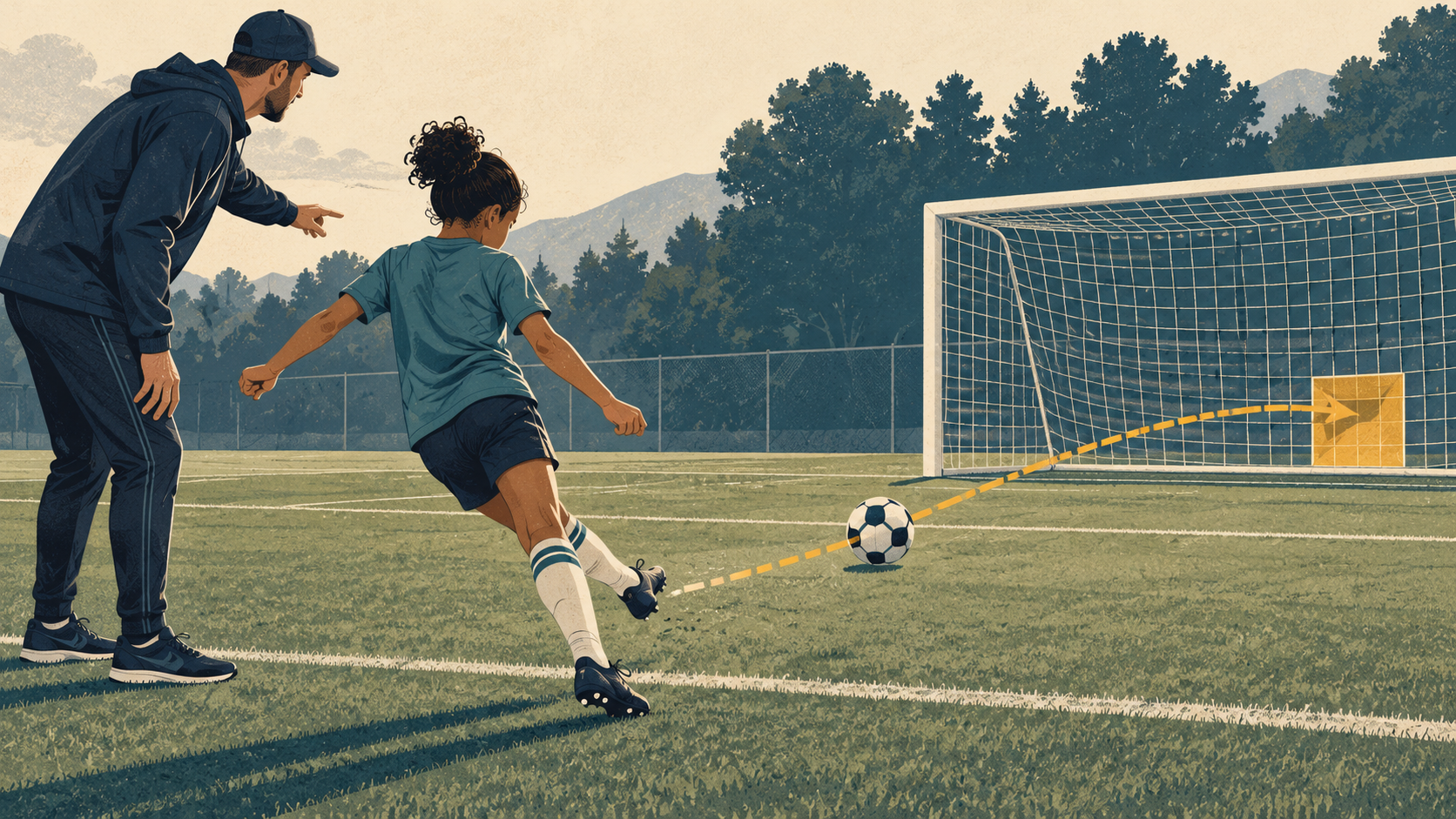
In the scenario, the coach demonstrates once and gives one cue: “Make the ball skim the grass all the way to your partner.” If a technical correction is needed later, it can be phrased in terms of the ball: “Hit the ball so it stays below knee height.” Avoid stacking internal and external cues during the same attempt.
Evidence and Boundaries
The attentional focus literature is large. A 15-year review (Wulf, 2013) and a systematic review and meta-analysis (Chua et al., 2021) reported advantages for an external focus for performance, retention, and transfer across ages and skill levels. Soccer was part of the early evidence: novices learning a lofted pass learned more effectively from feedback phrased in external rather than internal terms (Wulf et al., 2002).
The size of the effect, however, is now contested. A robust Bayesian re-analysis of the data behind earlier meta-analyses found moderate to strong evidence of publication bias, and after correction the estimated advantages for performance, retention, and transfer were small to negligible (McKay et al., 2024). A defensible reading of the evidence is therefore more modest than earlier claims: effect-focused cues are cheap, rarely harmful, and may help, but they are not a reliable shortcut to learning, and an internal cue is sometimes the clearest way to explain an unfamiliar action. This is a principle to apply and then test with your own players, not one to treat as settled.
Drills
Five drills for this principle (Drills 4A to 4E), each with a setup diagram, are in the drill appendix, page 11.
How to Know It Worked
Use a retention set at the next session in which the coach gives no cue. If the effect-focused instruction helped, accuracy and fluency should hold up without the reminder. Compare with a baseline set recorded before the cue change. Remember that an improvement in the same session reflects performance, which a cue can change immediately; learning is the change that remains.
- Phrase cues in terms of the intended effect on the ball or target when you can.
- Give one concise cue per attempt; do not stack body-part instructions.
- Internal cues remain appropriate for safety or for explaining an unfamiliar action.
- Recent bias-corrected analyses suggest the advantage is smaller than once claimed.
- Judge cues by retention without the cue, not by the next attempt.
Principle #5: Augmented Feedback
Using KR and KP to Guide Skill Improvement
The Concept
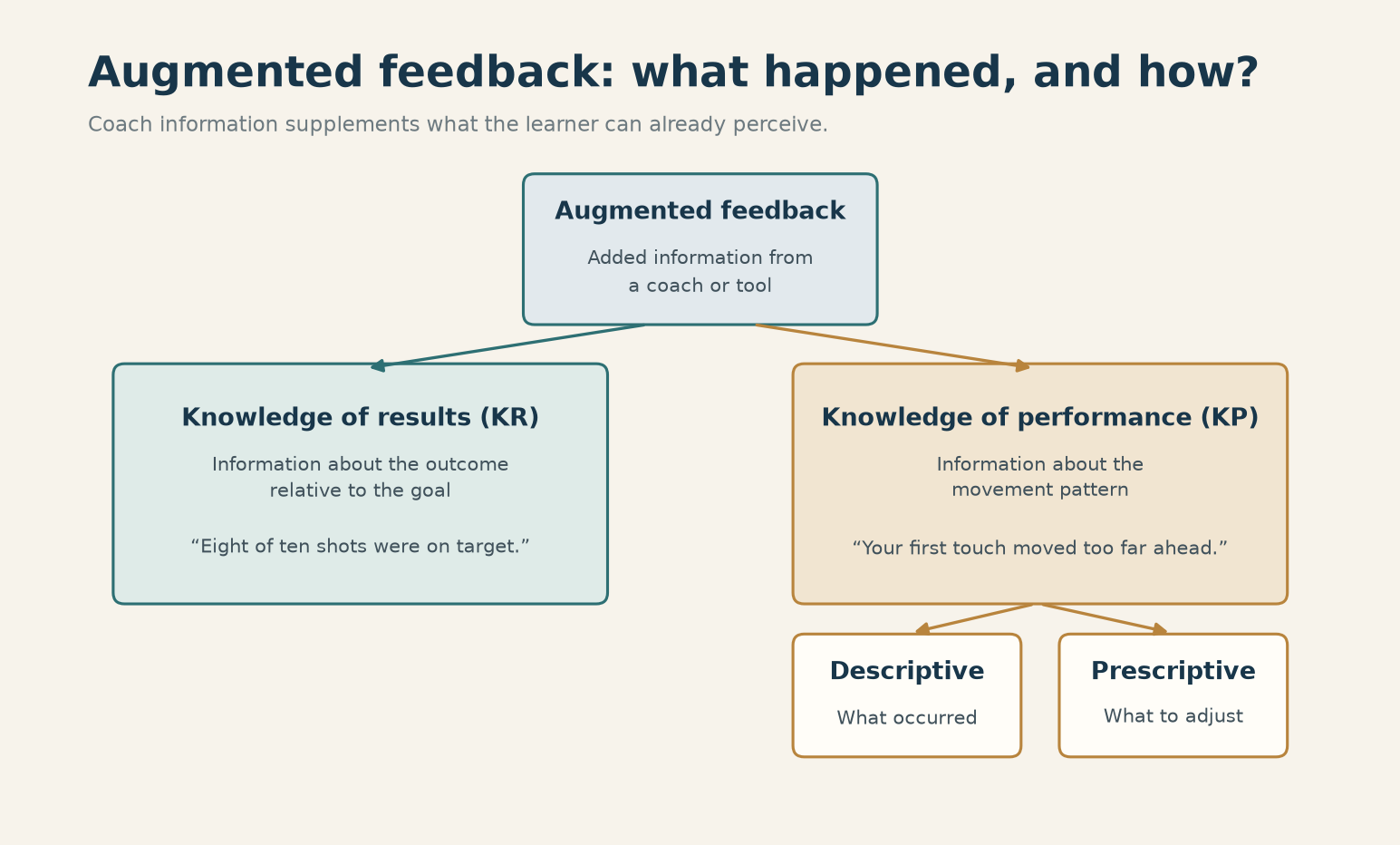
Players receive intrinsic feedback from their own senses every time they act: they see where the ball went, feel the contact, and hear the strike. Augmented feedback is information added from an external source, such as a coach, a teammate, or a video (Magill & Anderson, 2017). It takes two main forms. Knowledge of results (KR) describes the outcome relative to the goal: “Eight of ten shots reached the target area.” Knowledge of performance (KP) describes the movement that produced the outcome: “Your first touch moved the ball beyond your next playing distance.” KP can be descriptive (what happened) or prescriptive (what to change).
Augmented feedback can serve two roles at once. It provides information that helps the learner correct errors, and it can motivate by signaling progress and competence (Magill & Anderson, 2017; Wulf & Lewthwaite, 2016).
After this section, a coach should be able to choose between KR and KP for a given error, phrase feedback so it is observable, actionable, and tied to the task goal, and use video with a specific viewing question.
Coaching Scenario: “Good Job, Unlucky, Again”
An under-12 coach is enthusiastic and positive. During a passing-and-receiving activity, the coach calls out after nearly every attempt: “Good job!”, “Unlucky!”, “Again!” Players enjoy the energy, but after a month the same errors persist: first touches bounce away, and passes drift behind the receiver. When asked what they are working on, players say “passing.”
The problem: the feedback is frequent but carries almost no information. “Good job” and “unlucky” repeat what the player already saw (an outcome the player can perceive intrinsically) without identifying the movement feature that produced it. The players have encouragement but no basis for change.
The Solution
Before giving any feedback, the coach asks two questions (Magill & Anderson, 2017):
- Could the player see the result? If so, KR adds little. Ask the player to estimate the result first, then confirm or correct it.
- Is the cause observable, actionable, and connected to the task goal? If so, give one KP statement about that cause.
In the scenario, the coach replaces general praise with specific information: “Your first touch went across your body on three passes, so you had to take a second touch before passing.” The coach then gives one prescriptive change, phrased toward the effect: “Let the first touch carry the ball toward where your next pass is going.”

Encouragement still has a place. Feedback that highlights what went well, delivered after relatively successful attempts, can support motivation and learning (Chiviacowsky & Wulf, 2007). The goal is to pair encouragement with information, not to remove it.
Evidence and Boundaries
A systematic review of augmented feedback for gross motor and sport-specific skills concluded that the evidence is heterogeneous, with wide variation in tasks, populations, and outcome measures, and that it is not yet strong enough to support one universal feedback formula (Petancevski et al., 2022). A broader review of visual, auditory, haptic, and multimodal feedback found that concurrent feedback (given during the action) often helps acquisition but can create dependence in simple tasks, while complex tasks may benefit from more feedback, especially early in learning (Sigrist et al., 2013). Feedback phrased in external terms has shown advantages over internal phrasing in soccer and volleyball tasks (Wulf et al., 2002), although that finding is subject to the caveats on attentional focus in Principle #4.
Video feedback deserves a specific caution. It provides rich KP, but young learners may not know what to look for; without a viewing question, a clip is closer to entertainment than to information.
Drills
Five drills for this principle (Drills 5A to 5E), each with a setup diagram, are in the drill appendix, page 13.
How to Know It Worked
Two indicators matter. First, players’ estimates of their own results should become more accurate across sessions, which shows growing error detection. Second, the target error (for example, first touches that require a second touch before the pass) should decrease in a game form at the next session, when the coach gives no feedback during play. Fewer errors only while the coach is speaking reflect performance, not learning.
- KR repeats what the player can often see; ask for the player’s estimate first.
- KP is most useful when the cause is observable, actionable, and tied to the task goal.
- Give one KP statement at a time, preferably phrased toward the effect.
- Pair encouragement with information rather than replacing information with praise.
- Use video with a specific viewing question.
Principle #6: Feedback Frequency
Less Can Be More: Summary, Bandwidth, and Self-Selected Feedback
The Concept
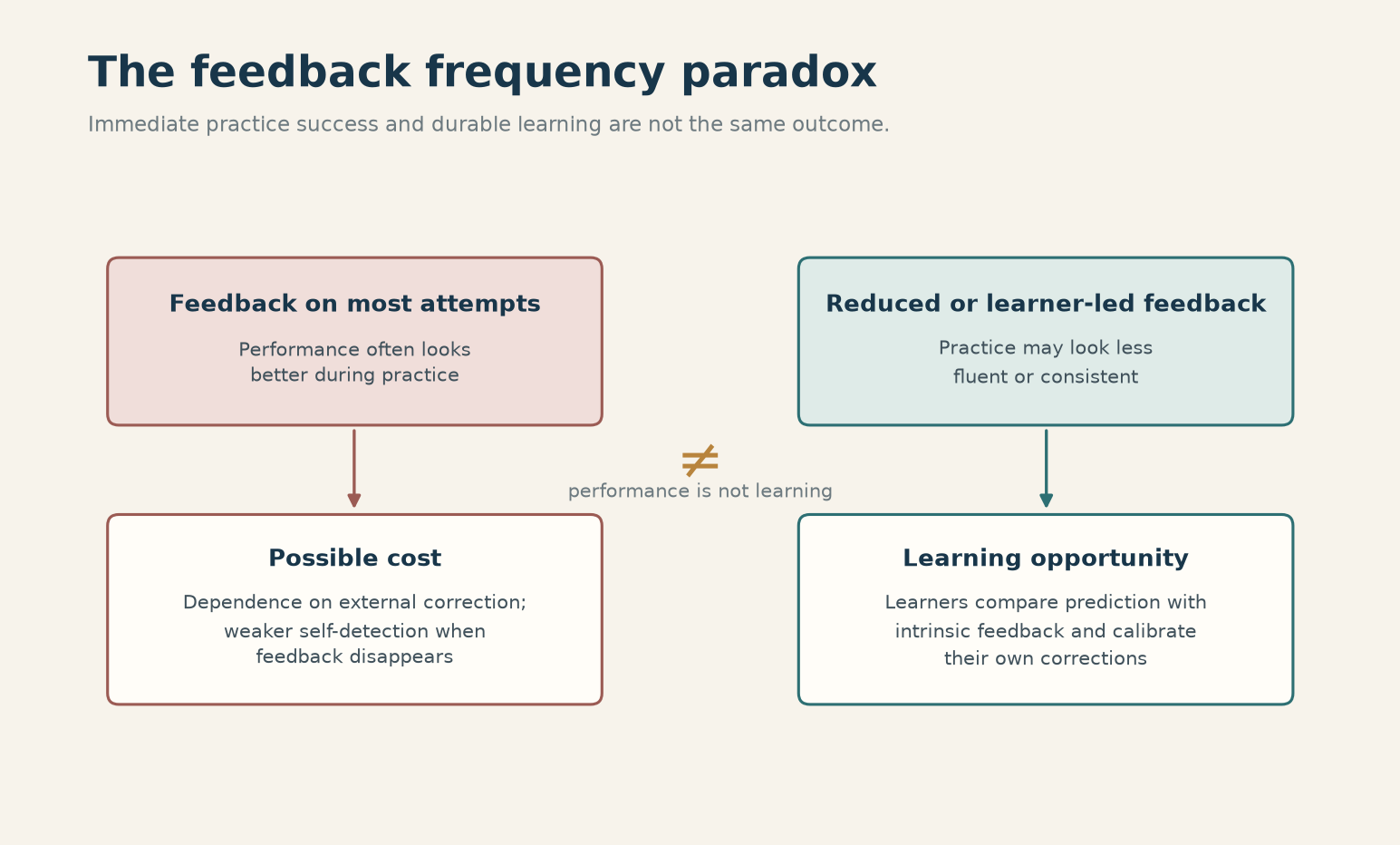
Feedback can be essential, but more is not always better. The guidance hypothesis proposes that very frequent augmented feedback guides the learner toward the correct movement during practice, improving immediate performance, while reducing the learner’s need to process intrinsic feedback and estimate errors independently. When the feedback is removed, performance can decline (Salmoni et al., 1984; Winstein & Schmidt, 1990). Coaches can reduce dependence by changing when feedback is given:
- Summary feedback: describe a pattern across a set of attempts after the set ends (Salmoni et al., 1984).
- Faded feedback: start with frequent feedback and reduce it as the skill stabilizes (Winstein & Schmidt, 1990).
- Bandwidth feedback: give feedback only when performance falls outside an agreed range (Sherwood, 1988).
- Self-selected feedback: let the learner request feedback when it would help (Chiviacowsky & Wulf, 2002).
After this section, a coach should be able to choose a feedback schedule (summary, faded, bandwidth, or self-selected) for a given learner and task, explain it to players, and test whether players can self-correct when the coach is silent.
Coaching Scenario: The Coach Who Is Always Talking
An under-11 coach corrects nearly every touch during a passing activity. Players perform well while the coach stands beside them. When the coach moves to work with another group, the same players stall, look across the field for confirmation, or repeat the same error several times in a row. In matches, where the coach can say little, technique fades.
The problem: the players have learned to rely on the coach’s correction rather than on their own detection of errors. The feedback schedule guided performance during practice but gave players few opportunities to evaluate their own attempts.
The Solution
The coach does not stop giving feedback; the coach changes its timing and tells the players how the new schedule works. Silence must not become an ambiguous signal.
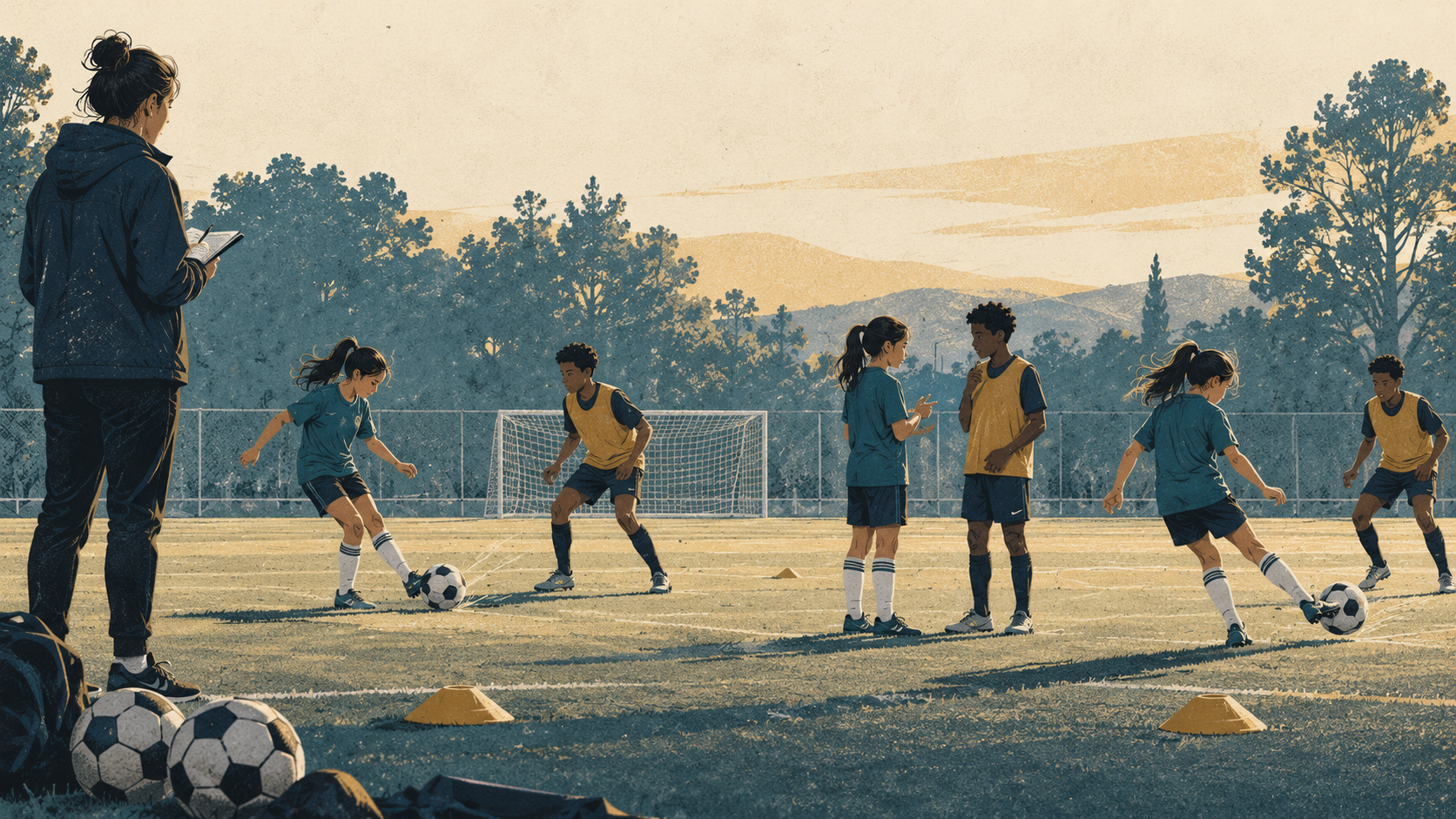
In the scenario, the coach announces a bandwidth: “I’ll only say something if the pass misses the gate. If I’m quiet, you’re inside the target.” After each five-pass set, the coach asks the passer to describe what happened before adding one summary statement. As players improve, the gate narrows. With older or more experienced players, the coach offers feedback on request: “Try three repetitions, decide what changed, and then ask me for one piece of information if you need it.”
Evidence and Boundaries
The guidance hypothesis has a strong theoretical basis and early laboratory support. Classic studies found retention benefits from reduced or faded KR (Winstein & Schmidt, 1990) and from summary KR (Salmoni et al., 1984), and bandwidth KR improved movement consistency (Sherwood, 1988). Two caveats limit how far these findings can be pushed.
First, the size of the reduced-frequency benefit is uncertain. A 2022 meta-analysis concluded that the evidence does not yet confirm a reliable learning advantage of reduced relative feedback frequency, citing limitations in much of the existing research (McKay et al., 2022). Second, much of the classic work used simple laboratory tasks with adults. Complex sport skills may require more information, especially early in learning (Petancevski et al., 2022; Sigrist et al., 2013).
Self-selected feedback has a similar history. Early studies reported learning benefits (Chiviacowsky & Wulf, 2002), but later, better-powered experiments and bias-adjusted analyses question whether choice itself produces a reliable advantage (St. Germain et al., 2023). Learner control remains useful for promoting reflection and partnership, but it is not a guaranteed learning effect.
Drills
Five drills for this principle (Drills 6A to 6E), each with a setup diagram, are in the drill appendix, page 16.
How to Know It Worked
Plan a coach-silent block at the next session: the same task, no feedback at all. Count errors and observe whether players correct themselves between attempts. Compare with a coach-silent block recorded before the change. If performance holds up without the coach and players can describe their own errors, the schedule has supported learning rather than dependence.
- Very frequent feedback can improve practice performance while limiting self-correction.
- Summary, faded, bandwidth, and self-selected schedules reduce dependence.
- Tell players how the schedule works so silence is not ambiguous.
- Recent meta-analyses suggest the benefits are smaller and less certain than early studies implied.
- Test with a coach-silent block, not by watching practice while you are coaching.
Principle #7: Whole vs. Part Practice
Find the Right Balance for Complex Skills
The Concept
When teaching a soccer skill, a coach can practice the whole skill or temporarily isolate a part. Naylor and Briggs proposed that the decision depends on two task characteristics: complexity, the number of components and the information-processing demands, and organization, how tightly the components depend on one another in space and time (Naylor & Briggs, 1963). Highly organized skills should usually be practiced whole, because splitting them destroys the timing that links the parts. Highly complex skills with low organization are better candidates for part practice (Magill & Anderson, 2017).
Part practice is not one method. Three versions are commonly distinguished (Magill & Anderson, 2017; Wightman & Lintern, 1985):
- Fractionization: practicing separate components independently.
- Segmentation: practicing one part, then adding the next part, and so on (also called progressive part practice).
- Simplification: practicing the whole skill with reduced difficulty, such as slower speed, a passive defender, or a lighter ball.
After this section, a coach should be able to classify a skill by complexity and organization, choose among whole practice, segmentation, and simplification, and reconnect any isolated part to the full action quickly.
Coaching Scenario: The Step-Over That Disappears
An under-13 coach teaches a step-over, acceleration, and shot sequence. Players practice the step-over footwork in place for ten minutes until it looks fluent. When the full sequence is introduced with a defender, the move falls apart: players perform the step-over too early, too close to the defender, or without accelerating afterward. Several stop running after the step-over, as they did when practicing it in place.
The problem: the coach fractionized a skill whose value depends on its connection to the defender and to the acceleration that follows it. The isolated footwork was practiced without the timing information that triggers it, and it was practiced long enough to become a habit of its own.
The Solution
The coach first classifies the sequence. The step-over itself is a short, highly organized action. The full sequence, however, contains separable problems: the feint, the change of speed, and the finish, each with its own timing relative to the defender. That combination makes it a candidate for segmentation or simplification, not prolonged fractionization.
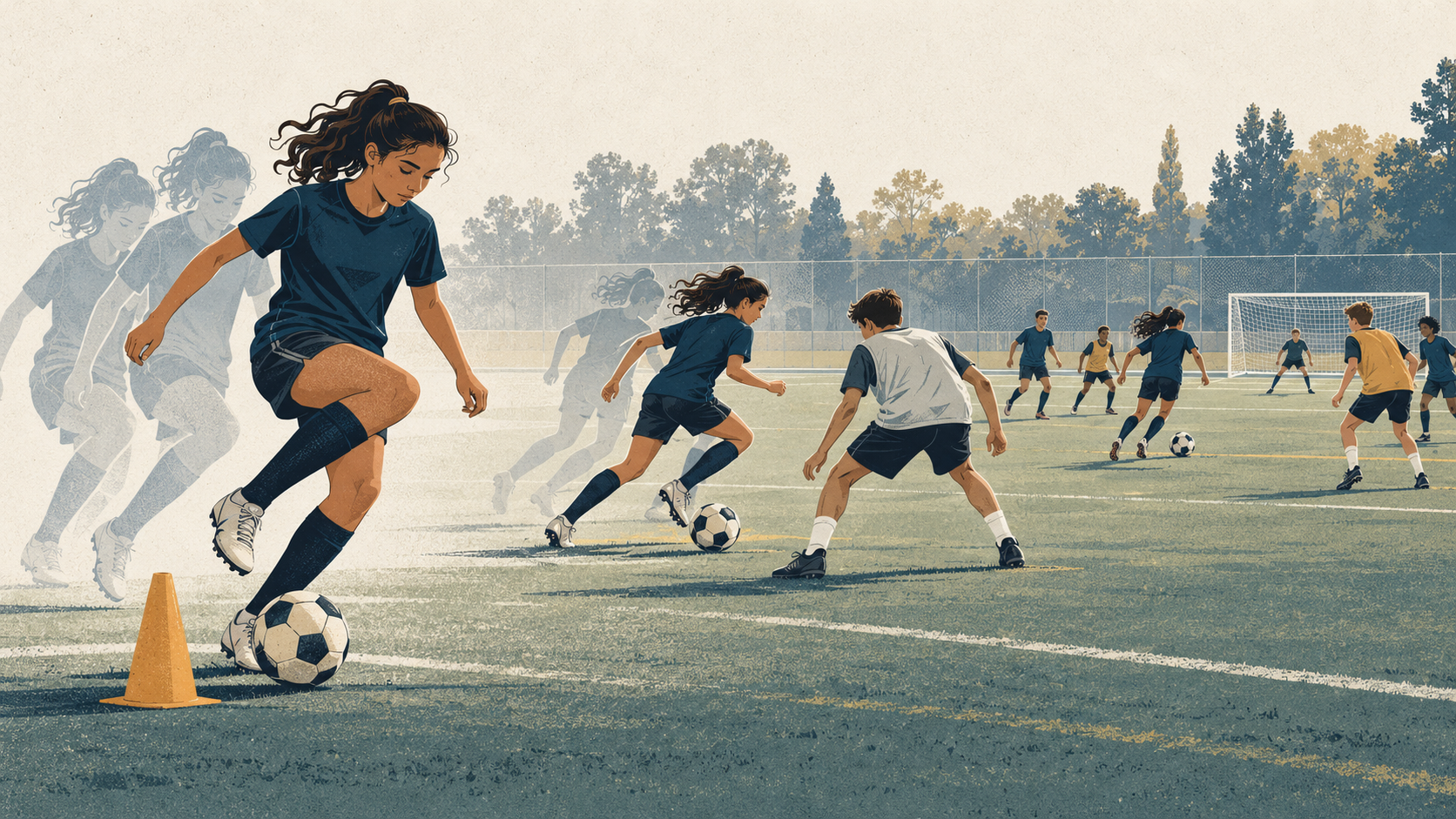
In the scenario, the coach isolates the step-over only long enough to establish its rhythm, a minute or two, and then chains it to the acceleration, then to the shot, and finally to a live defender. Alternatively, the coach keeps the whole sequence and simplifies it: a passive defender at walking pace who gradually becomes active. Simple, highly organized actions, such as an inside-foot pass, stay whole because approach, contact, and follow-through form one short coordination pattern.
Evidence and Boundaries
The complexity-and-organization heuristic is the standard textbook recommendation (Magill & Anderson, 2017; Naylor & Briggs, 1963). A meta-analysis of 20 studies comparing whole and part practice found that mean effect sizes generally supported the textbook recommendations, but several analyses were compromised by the small number of available studies, and the authors called for more research before the recommendations can be considered well verified (Fontana et al., 2009). Wightman and Lintern’s review of part-task training found segmentation and simplification more consistently useful than fractionization for tasks with time-shared components (Wightman & Lintern, 1985).
Learner development also matters. In a juggling study, younger and older children responded differently to part and whole schedules, with no overall retention or transfer advantage across all ages (Chan et al., 2015). Part–whole decisions should therefore be tested with the actual learner rather than treated as a fixed property of the task.
Drills
Five drills for this principle (Drills 7A to 7E), each with a setup diagram, are in the drill appendix, page 18.
How to Know It Worked
Evaluate the reintegrated action, never the isolated part. In a defended 1v1 at the next session, count how often the attacker beats the defender with the move and gets a shot away. Improvement in the step-over performed in place does not establish that the whole skill improved.
- Decide with complexity and organization: highly organized skills stay whole.
- Part practice includes fractionization, segmentation, and simplification; the latter two are usually safer.
- Isolate a part only long enough to establish it, then reconnect it to the information that triggers it.
- A meta-analysis supports the textbook heuristic, but the evidence base is small.
- Test the whole skill in a defended situation.
Principle #8: Distribution of Practice
Distribute Practice When Quality Declines
The Concept
How practice and rest are scheduled can affect both performance and learning. Massed practice provides relatively little rest between attempts or sessions; distributed practice provides longer or more frequent rest intervals (Magill & Anderson, 2017). Distribution can be arranged at two levels: between attempts within a session (intertrial intervals) and between sessions across days. The same total practice time can be scheduled as one long session or as several shorter ones.
A plausible mechanism is that spacing gives the nervous system time to consolidate what was practiced, and it limits the fatigue and attentional decline that reduce practice quality toward the end of a long block (Schmidt et al., 2019; C. H. Shea et al., 2000).
After this section, a coach should be able to recognize when fatigue or attention loss is degrading practice quality, and to distribute practice within and across sessions so that repetitions remain worth learning from.
Coaching Scenario: The 90-Minute Saturday
An under-10 coach can only access the field once a week, so the team practices for 90 minutes on Saturday mornings, with one long dribbling and receiving block in the middle. For the first 20 minutes, first touches are sharp. By the last 20 minutes, players are dragging, passes are sloppy, and several players are playing their own games at the side of the area. The coach responds by adding more repetitions “because they need the work.”
The problem: the later repetitions no longer resemble the intended action. Fatigue and attention loss mean players are practicing a degraded version of the skill, and the coach is interpreting a scheduling problem as a motivation problem.
The Solution
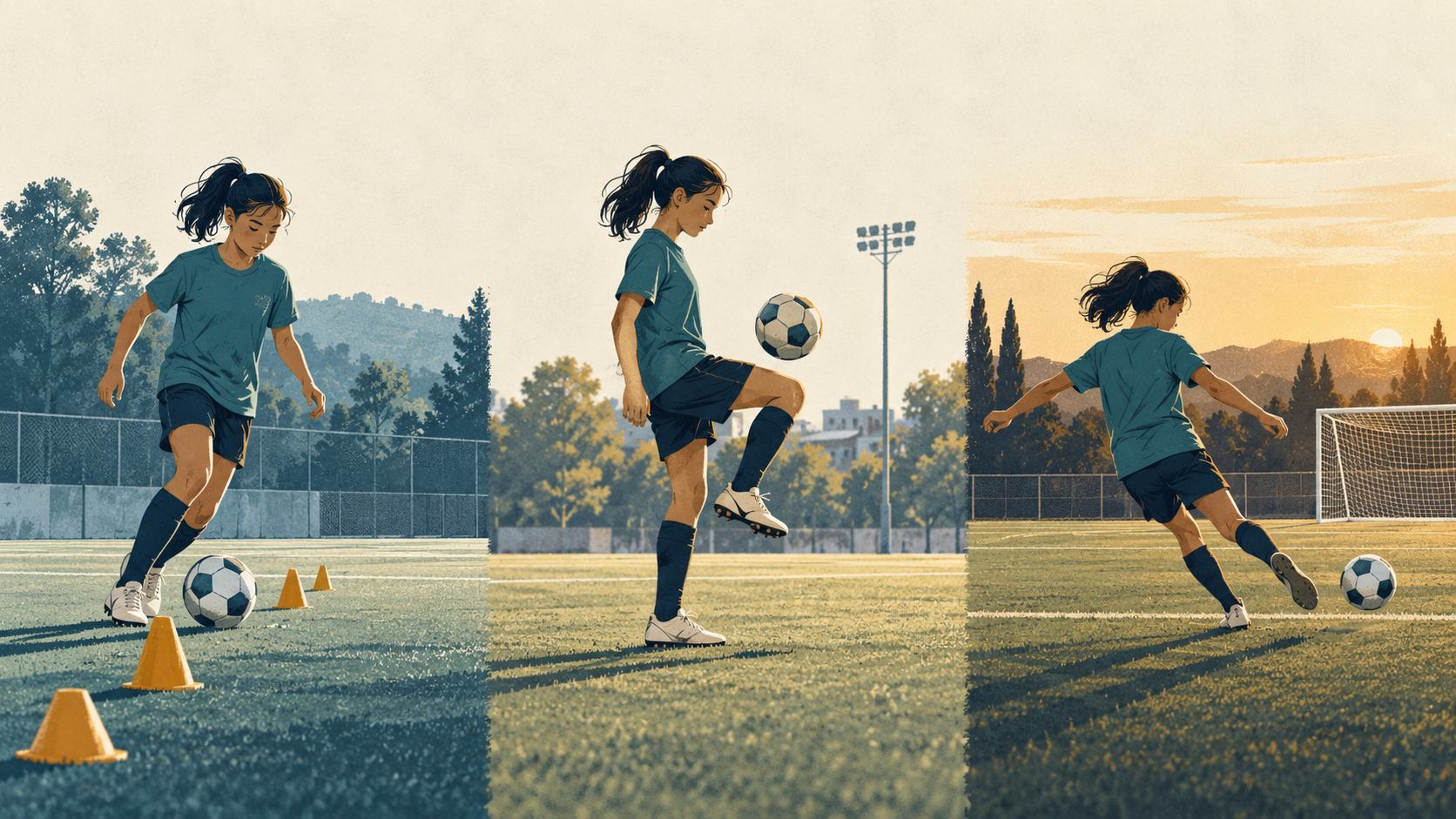
The coach keeps the total practice time but redistributes it. Within the session, the receiving objective is split into three short blocks separated by different activities, such as a small-sided game or a fun relay. Across the week, players receive a short home challenge that takes ten minutes, several days a week.
The coach also watches for signals that justify rest or a task change more convincingly than a fixed rule about session length: declining decision quality, slower recovery between efforts, frustration, or repetitions that no longer resemble the intended action.
Evidence and Boundaries
Lee and Genovese’s review found the clearest distributed-practice benefits for continuous tasks and absolute retention measures, while also documenting disagreement across tasks and outcome definitions (Lee & Genovese, 1988). A larger meta-analysis across motor and verbal tasks confirmed an overall spacing effect but found that it became smaller as task complexity increased (Donovan & Radosevich, 1999). Laboratory work also shows that spacing practice sessions across days can benefit retention compared with completing the same practice in one day (C. H. Shea et al., 2000).
The implication for soccer is not simply “shorter is always better.” Soccer skills are complex, which may reduce the size of the spacing benefit, and very short sessions can limit the time available for game-based practice. Distribution is most clearly justified when fatigue, attention loss, or declining movement quality prevents useful information from being processed. Total load, safety, and the child’s broader schedule also matter.
Drills
Five drills for this principle (Drills 8A to 8E), each with a setup diagram, are in the drill appendix, page 21.
How to Know It Worked
Track quality within and across sessions. Within a session, tally clean first touches out of ten at the start and end of each block; the block structure is working if the late tallies stay close to the early ones. Across sessions, test the receiving skill at the start of the next practice, before any warm-up drills on that skill. Better retention at the next session, not a busier final 20 minutes, is the evidence that distribution helped.
- Repetitions only help when they resemble the intended action.
- Distribute practice within a session (short blocks) and across days (short, frequent practice).
- The spacing effect is robust but smaller for complex tasks such as soccer skills.
- Use declining quality, not a fixed clock, as the signal to rest or change task.
- Test at the start of the next session.
Principle #9: Stages of Learning
Tailor Coaching to Cognitive, Associative, and Autonomous Phases
The Concept
Paul Fitts and Michael Posner’s classic model describes three broad changes in skill acquisition: cognitive, associative, and autonomous (Fitts & Posner, 1967). In the cognitive stage, the learner works out what to do; errors are large and attention is consumed by the action. In the associative stage, the learner refines how to do it; errors decrease and the learner begins to detect some of them. In the autonomous stage, the action requires little conscious attention under familiar demands, freeing attention for other information.
Gentile’s two-stage model adds a distinction that matters for soccer. The first stage is getting the idea of the movement. In the second stage, the goal depends on the skill: for closed skills performed in a stable environment, the learner works toward fixation, a consistent pattern; for open skills performed in a changing environment, the learner works toward diversification, a repertoire of adaptable solutions (Gentile, 1972). Most soccer skills are open, so the later stages of learning should build adaptability, not just consistency.
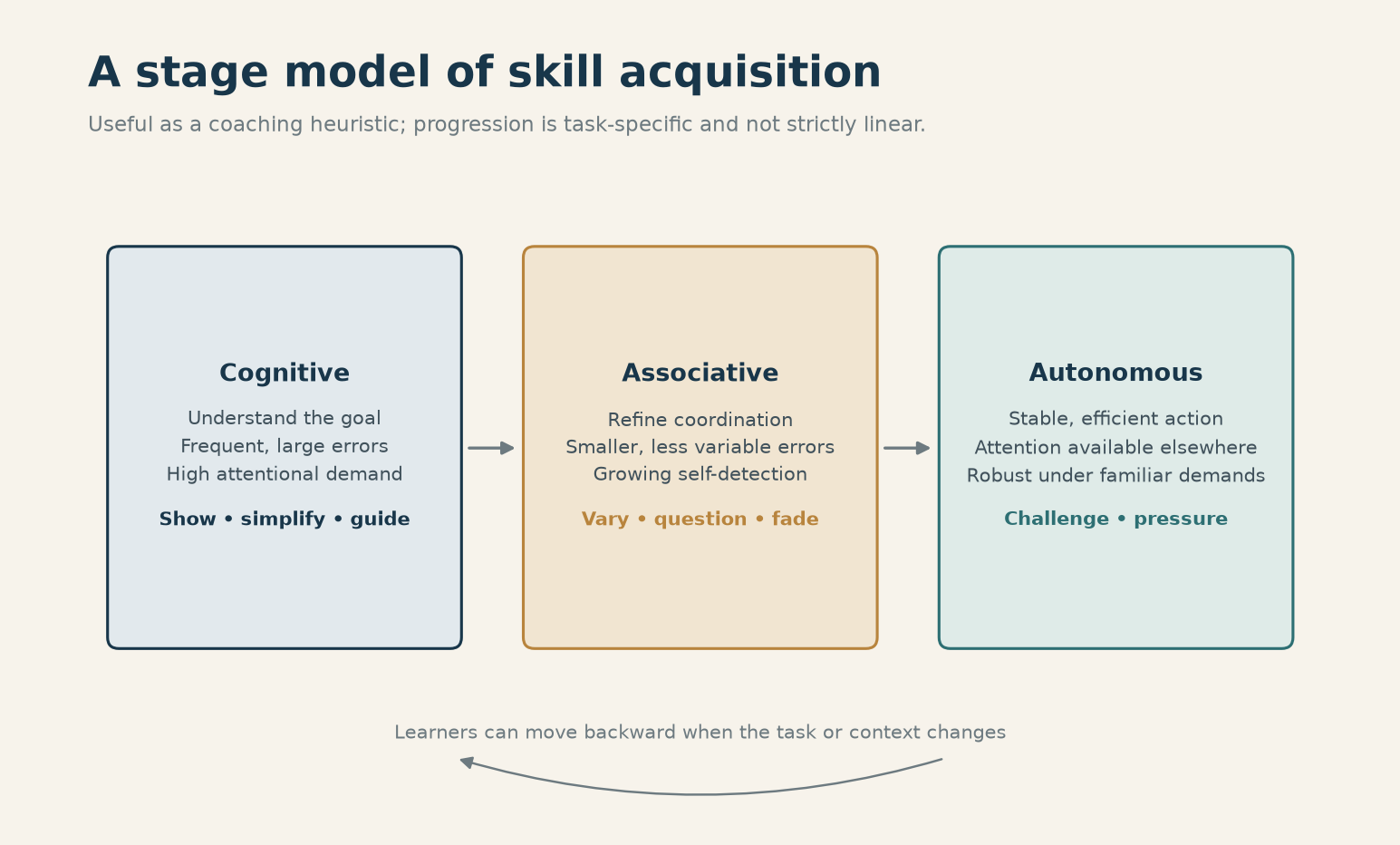
After this section, a coach should be able to identify a player’s stage for a specific skill under specific demands, and adjust instruction, feedback, and challenge accordingly within the same team activity.
Coaching Scenario: One Drill, Three Different Players
An under-12 team includes players who joined this season, players with a few years of club experience, and two players who also train at an academy. The coach runs one dribbling drill for everyone. The newer players look at the ball constantly, lose it often, and become discouraged. The academy players finish the drill easily and begin showing off. The middle group is engaged, but the coach’s instructions, aimed at “the team,” fit none of the three groups well.
The problem: the coach is treating the team as if it occupied one learning stage. The same drill is cognitive-stage work for some players and autonomous-stage repetition for others, and the instruction suits neither.
The Solution
The coach keeps one objective, dribbling with control while gathering information, and adjusts constraints, cues, and feedback for each stage.
| Stage | Characteristics | Coaching Approach | Example in Soccer |
|---|---|---|---|
| Cognitive | • High error rate • Conscious processing • Slow execution |
• Short demonstration, one cue • Simple, learnable task • Encouragement with information |
Beginner learning to dribble: looks down constantly, thinks about each touch |
| Associative | • Reduced errors • Smoother movements • Some self-detection of errors |
• Add variability • Reduce feedback frequency • Ask for self-analysis |
Can dribble while occasionally looking up; adjusting touch with less conscious thought |
| Autonomous | • Highly reliable • Little conscious attention needed • Can attend to other information |
• Representative pressure • Secondary decisions • Tactical focus |
Dribbles naturally while scanning field and making tactical decisions |

In the scenario, the coach runs the same activity in three lanes (Drill 9A in the appendix) and uses a simple dual-task check (Drill 9B) to decide which lane each player starts in. Players move between lanes as their performance changes. A new constraint can return the same learner to deliberate control, so the coach classifies the skill–context relationship, not the player.
Evidence and Boundaries
The Fitts and Posner model is a descriptive heuristic, not a diagnostic test or a fixed staircase (Fitts & Posner, 1967; Magill & Anderson, 2017). Its stage boundaries are fuzzy, and learners can move backward when speed, pressure, or tactical demands increase. Gentile’s model is equally descriptive but adds the useful open/closed distinction (Gentile, 1972). One line of research suggests a caution about cognitive-stage instruction: learners who accumulated a large amount of explicit, rule-based knowledge during practice were more likely to see performance break down under pressure than learners who practiced with little explicit instruction (Masters, 1992). That finding, from golf putting, supports keeping early instruction short and focused rather than front-loading detailed technical rules.
Drills
Five drills for this principle (Drills 9A to 9E), each with a setup diagram, are in the drill appendix, page 24.
How to Know It Worked
Two checks fit this principle. First, repeat the dual-task scan check every few weeks; fewer lost balls and more correct calls indicate that the skill is becoming more automatic. Second, observe whether players can maintain dribbling quality when pressure is added in a small-sided game. Performance that holds up under added demands is the best practical sign that a skill has moved toward autonomy for that context.
- Stages describe a skill in a context, not a player; one player can be at different stages for different skills.
- Most soccer skills are open, so later stages should build adaptability, not only consistency.
- Keep cognitive-stage instruction short; avoid front-loading technical rules.
- Run one objective at several difficulty levels within the same activity.
- Use dual-task and added-pressure checks to judge progress.
Principle #10: Practice Like You Play
Preserve Perception–Action Coupling
The Concept
This principle extends specificity (see Principle #1) from individual skills to the full game. Its foundation is representative design, a term from Brunswik’s work on perception: an experiment, or a practice task, should sample the information present in the environment to which the findings are meant to apply (Brunswik, 1956). Representative learning design applies this idea to sport. It asks whether practice preserves the information that guides action in competition: Can the player see a defender’s approach, perceive space, choose among real options, and act under meaningful timing pressure? (Pinder et al., 2011).
From an ecological dynamics perspective, perception and action are tightly coupled: players act on affordances, opportunities for action that they perceive in the environment, such as a gap between defenders (Araújo et al., 2006). The constraints-led approach gives coaches a practical tool: shape behavior by manipulating constraints of the task (rules, space, numbers, equipment), the environment, and the individual, rather than by prescribing one correct technique (Button et al., 2021; Newell, 1986; Renshaw et al., 2019).
After this section, a coach should be able to design a small-sided game in which the rules and space amplify a target problem without removing the player’s choice.
Coaching Scenario: The Drill-Perfect, Decision-Poor Team
An under-13 coach runs well-organized sessions: passing patterns, unopposed technical circuits, and a short scrimmage at the end. Players execute the patterns crisply. In matches, the team rarely plays forward. Midfielders receive facing their own goal, take extra touches before deciding, and pass sideways or backward even when a forward pass is available.
The problem: most practice time is spent in activities in which the decision is predetermined. The passing patterns tell players where the ball goes next, so players have practiced executing passes but not finding them. This pattern, in which training-form activities dominate playing-form activities, has been documented in youth soccer coaching (Ford et al., 2010).
The Solution
The coach designs a game in which the target problem, playing forward, appears often and is rewarded, while defenders still decide where to press. The constraints are chosen to amplify the problem without scripting the answer.
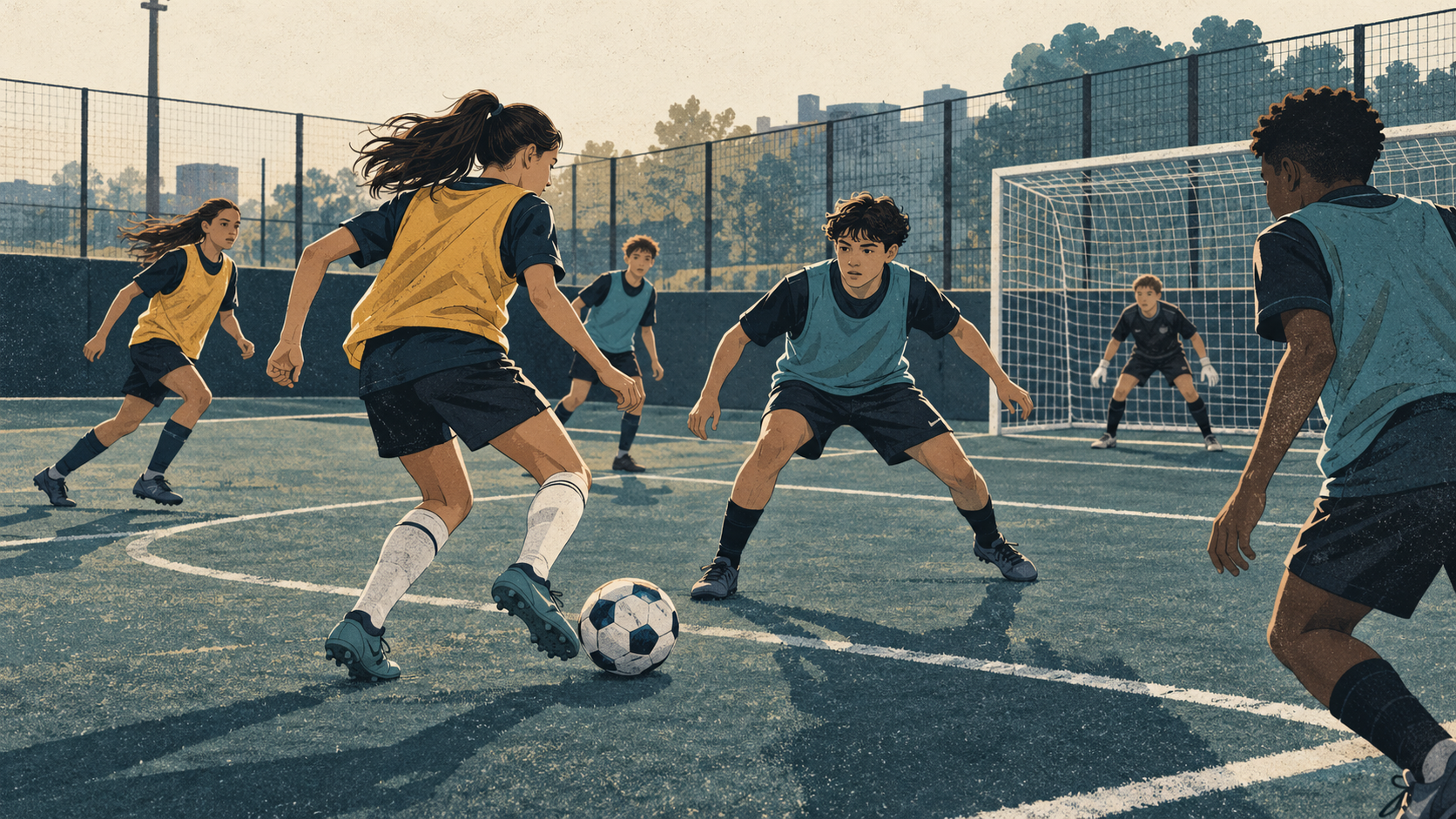
In the scenario, the coach uses a 4v4 game with end zones (Drill 10A in the appendix). A team scores by receiving the ball in the end zone, which rewards forward passes and forward runs. Two end zones per side prevent defenders from guarding one predetermined route. Pitch width changes the available passing angles. Because midfielders who receive facing backward are a large part of the problem, the coach also adds a constraint that rewards scanning before receiving (Drill 10B); in elite match play, players who scanned more had a higher probability of completing their passes, although the association was small (Jordet et al., 2020).
Representative practice does not require match intensity throughout the session. Coaches can simplify player numbers, space, or rules while preserving the perception–action relationship.
Evidence and Boundaries
Representative learning design is a well-developed theoretical framework (Araújo et al., 2006; Pinder et al., 2011), and the constraints-led approach is set out in detail in applied coaching texts (Button et al., 2021; Renshaw et al., 2019). A systematic review of youth team-sport teaching supports small-sided games as a way to increase ball contacts and manipulate technical–tactical problems, while emphasizing that rules and space must be selected for the intended learning goal (Fernández-Espínola et al., 2020). An umbrella review of systematic reviews linked small-sided games to technical and tactical improvements, but rated most of the included reviews as low or critically low in methodological quality and called for stronger experimental designs (Clemente et al., 2021).
The evidence therefore supports small-sided and conditioned games as a reasonable default for youth soccer, not as a proven replacement for every other activity. Technique work still has a place, particularly for cognitive-stage learners, provided it is reconnected to the game.
Drills
Five drills for this principle (Drills 10A to 10E), each with a setup diagram, are in the drill appendix, page 27.
How to Know It Worked
Use game-based measures recorded over several sessions: the number of completed forward passes into the end zone per game, the proportion of receptions in which the midfielder turns forward, and the number of scans before receiving. Then check the same behaviors in an ordinary match, where the conditioning rules are absent. A rise in forward play in the conditioned game alone shows that the rule works; a rise in the match shows transfer.
- Representative practice preserves the information and decisions that guide action in matches.
- Manipulate task constraints (space, rules, numbers) to amplify a problem without scripting the answer.
- Youth soccer practice has tended to overuse predetermined drills.
- Small-sided game evidence is supportive but of modest methodological quality.
- Test in an ordinary match, without the conditioning rules.
Principle #11: Observational Learning and Demonstration
Show With a Purpose, Then Let the Learner Act
The Concept
Observation can help learners form an initial representation of a movement, detect task-relevant information, and compare an attempted action with a model. Bandura’s social learning theory describes four processes that determine whether observation produces learning: attention (noticing the relevant features), retention (remembering them), production (being able to reproduce them), and motivation (wanting to) (Bandura, 1986). A demonstration that fails at any one of these processes, for example because the learner watched the wrong feature, will not help.
Research on what observers actually pick up suggests that learners extract information about the goal and the relative motion of the action more readily than precise body positions, and that demonstrations are most useful when the coordination pattern is new to the learner (Hodges et al., 2007).
After this section, a coach should be able to plan a demonstration by deciding who models, what the learner watches, from which angle, and when the learner attempts, and to use peers and video as models.
Coaching Scenario: The Full-Speed Cruyff Turn
An under-11 coach wants to teach the Cruyff turn. The coach performs it once at full speed while facing the players, says “Like that,” and sends them to practice. Players flail. Some turn the wrong way because they watched a mirror image. Others copy the arm movement but not the drag of the ball. After two minutes, the coach demonstrates again, faster, with a running explanation of every body part.
The problem: the demonstration gave players nothing specific to attend to, came from a viewing angle that reversed the movement, was too fast for beginners to encode, and was followed by an explanation that overloaded attention. The coach also had no way of knowing what the players had actually noticed.
The Solution
The coach plans the demonstration using the questions of an applied model of observation: who models, what is observed, when and where the observation happens, why it is used, and how it is delivered (Ste-Marie et al., 2012). In the scenario:
- Who: the coach first, then a peer who has recently learned the turn.
- What: one feature: “Watch where the ball goes after the inside of the foot drags it.”
- Where: players stand behind or beside the model so they see it from the same perspective they will use.
- When: players attempt within seconds of the demonstration, and the demonstration is repeated at intervals rather than only at the start.
- How: one slower demonstration, one at game speed, and no running commentary.
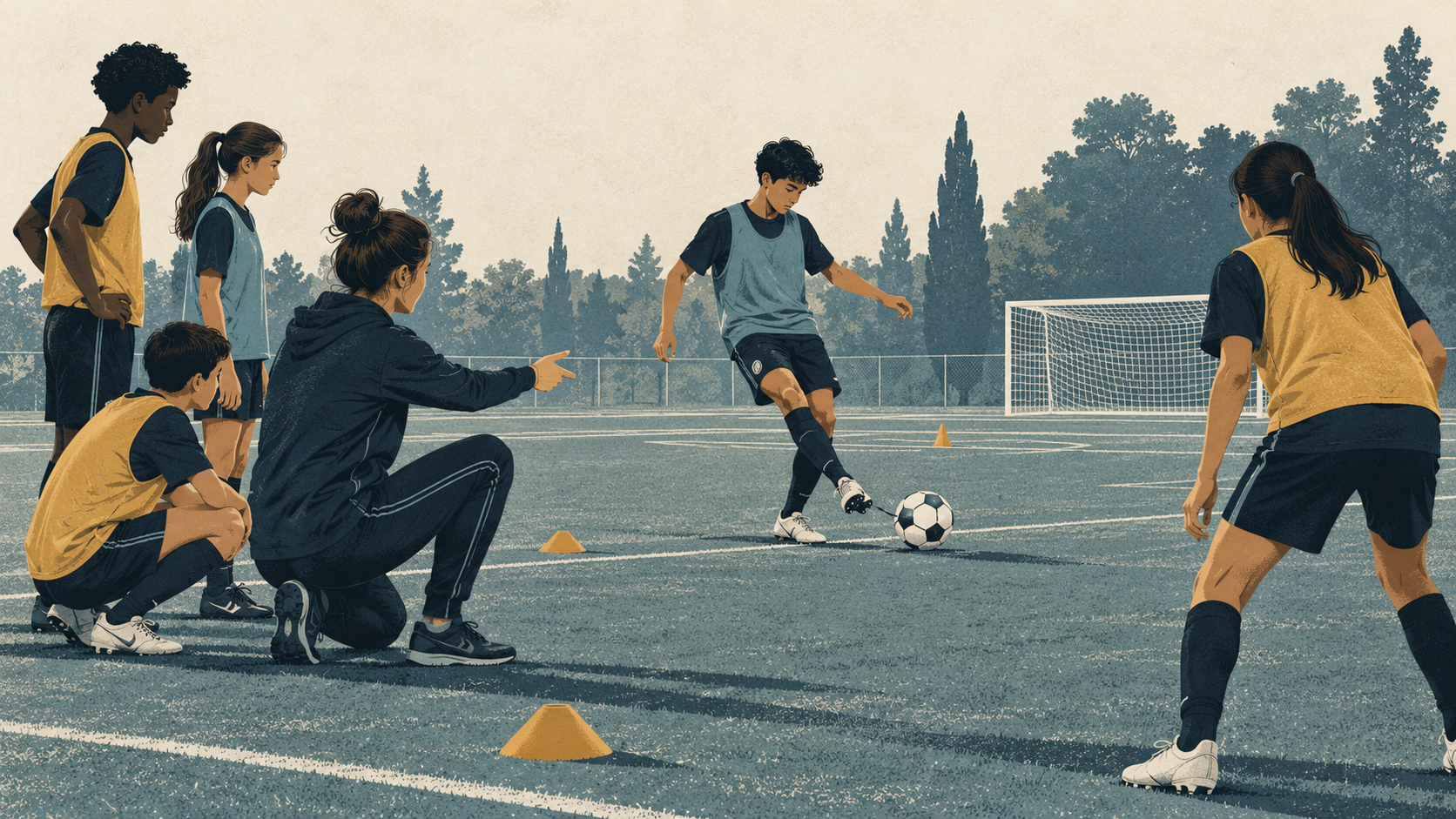
After two or three attempts, the coach asks: “What did you see, and what did you feel?” The answer tells the coach whether the attention step worked.
Evidence and Boundaries
A systematic review of 18 physical-education studies reported strong evidence that observational learning improved motor-skill learning compared with no observational learning. It found no clear superiority of an expert model over self-modeling and mixed evidence about adding verbal cues (Han et al., 2022). The applied model of observation organizes the research by function and context and highlights that observation is used for strategy and motivation, not only for skill (Ste-Marie et al., 2012).
Observation complements physical practice; it does not replace the sensory information created by executing the skill. Studies vary in model type, cueing, task, and retention measurement, so specific recommendations, such as the ideal number of demonstrations, are not firmly established.
Drills
Five drills for this principle (Drills 11A to 11E), each with a setup diagram, are in the drill appendix, page 29.
How to Know It Worked
At the next session, ask players to perform the skill without a new demonstration. If the earlier observation helped, players should reproduce the key feature, such as the ball being dragged behind the standing leg, and should be able to describe it. Comparing a retention attempt without demonstration with players’ first attempts in the earlier session shows whether the observation produced learning or only short-term imitation.
- Observation must succeed at attention, retention, production, and motivation.
- Give one feature to watch, from the learner’s own viewing angle.
- Let learners attempt within seconds, and repeat demonstrations at intervals.
- Peers, learning models, and self-video are useful alternatives to an expert.
- Test without a new demonstration at the next session.
Principle #12: Optimal Challenge
Match Functional Difficulty to the Learner
The Concept
The challenge point framework distinguishes nominal task difficulty, how difficult a task is in general, from functional task difficulty, how difficult it is for this learner, at this moment, under these conditions (Guadagnoli & Lee, 2004). Learning is expected to be greatest when practice supplies enough information and error to stimulate adaptation without making success or useful problem solving unlikely. The same 3v2 game may be routine for one group and overwhelming for another. The framework is closely related to Bjork’s notion of desirable difficulties: difficulties that slow practice performance but enhance long-term learning, provided the learner can respond to them successfully (Bjork, 1994).
Hodges and Lohse extended the framework for coaches. Their version adds the learner’s motivation and the specificity of practice, and distinguishes three purposes of practice: practice to learn new skills, practice to transfer skills to competition, and practice to maintain current skills, each of which calls for a different level of challenge (Hodges & Lohse, 2022).
After this section, a coach should be able to recognize when a task is too easy, productive, or too hard for a particular group, and adjust one constraint at a time to bring functional difficulty into a productive range.
Coaching Scenario: The 3v2 That Is Either Boring or Chaos
An under-12 coach runs the same 3v2 attacking game every week in a 30 × 25 m area. With the stronger group, the attackers score on nearly every attack and the defenders give up. With the less experienced group, the attackers lose the ball within two passes and the activity becomes a series of restarts. The coach keeps the game the same because “3v2 is a good game for this age.”
The problem: the coach is judging difficulty nominally. The game is the same for both groups, but its functional difficulty is too low for one and too high for the other. Neither group is in the range where errors are interpretable and solutions improve.
The Solution
The coach treats the game as a set of dials. Each constraint, including space, numbers, touches, time, and target size, changes functional difficulty.
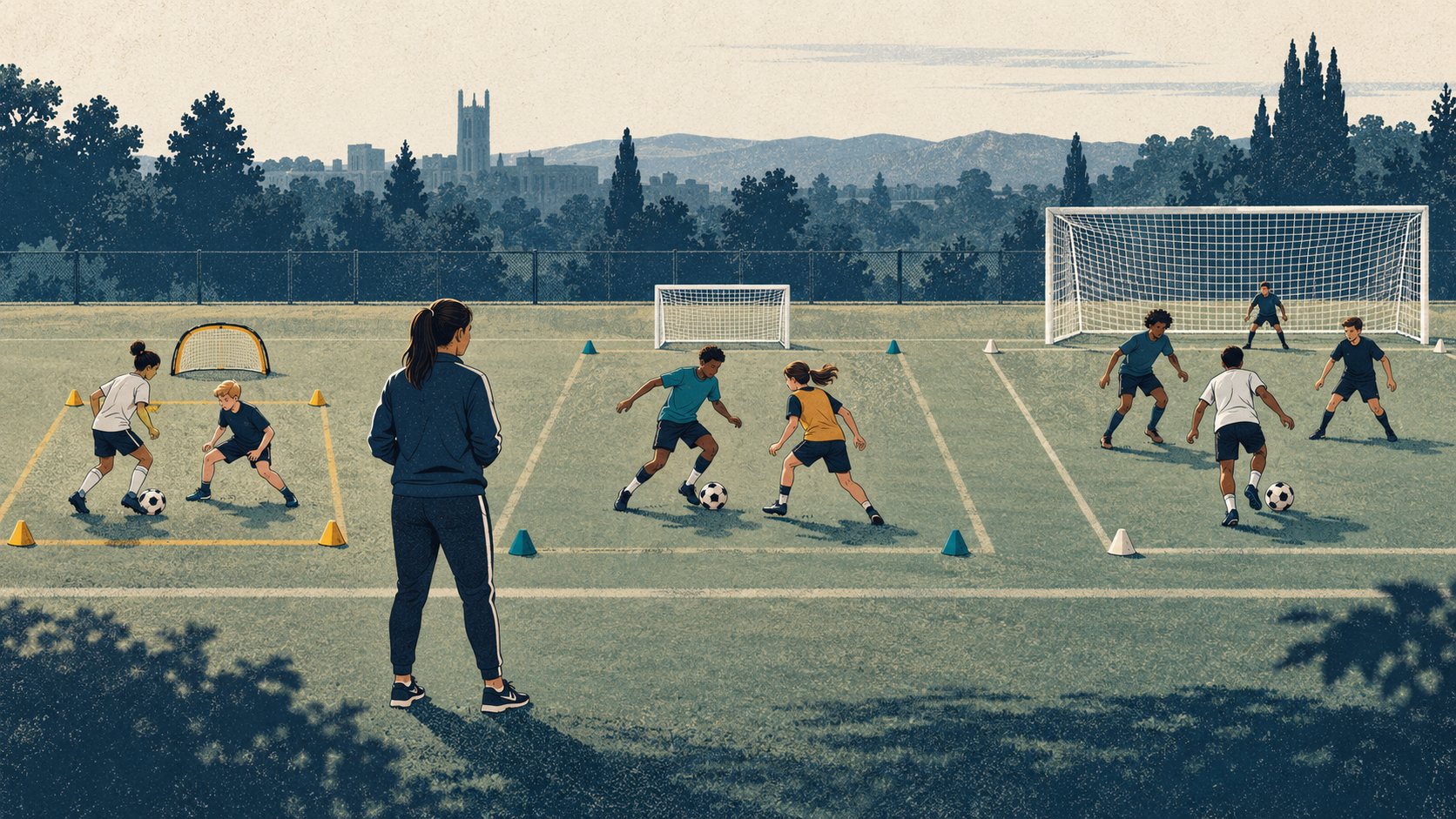
If a receiving-and-turning task is too easy, reduce space, add a recovering defender, require scanning before the pass, or shorten decision time. If it is too difficult, enlarge the space, slow the defender, create a numerical advantage, or simplify the target. Change one constraint at a time and watch the learner’s decisions, not only the success rate.
- Too little challenge: automatic success, little search, attention drifts.
- Productive challenge: errors are interpretable, solutions improve, engagement remains high.
- Too much challenge: repeated breakdown, guessing, avoidance, or loss of the task goal.
In the scenario, the stronger group plays in a narrower area with a recovering third defender; the less experienced group plays in a wider area with a neutral player who always supports the attack. Both groups now work at a productive level of challenge on the same objective.
Evidence and Boundaries
The challenge point framework is influential and has been cited widely in coaching science (Guadagnoli & Lee, 2004; Hodges & Lohse, 2022). It is, however, primarily a theoretical synthesis; its prediction of an optimal level of challenge for each learner is difficult to test directly, because the optimal point shifts as the learner improves and differs across tasks. The extended framework explicitly acknowledges motivation: tasks that are too hard can undermine the learner’s willingness to persist, and tasks that are too easy can reduce engagement (Hodges & Lohse, 2022; Wulf & Lewthwaite, 2016).
There is no evidence-based success rate that defines the “right” difficulty for every task. Coaches should use the calibration signs above, which rely on the type of errors and the learner’s engagement, rather than a single percentage.
Drills
Five drills for this principle (Drills 12A to 12E), each with a setup diagram, are in the drill appendix, page 32.
How to Know It Worked
Track the types of errors across sessions, not only whether errors decrease. Productive challenge is working when errors shift from loss of control to decision errors (for example, mistimed passes rather than lost touches), when players stay engaged, and when the dial must be turned toward greater difficulty over time to keep the challenge productive. A record of the dial settings that kept each group in the productive range is itself useful evidence of learning.
- Functional difficulty depends on the learner, not only on the task.
- Desirable difficulties slow practice but can enhance learning when learners can respond to them.
- Treat a game as a set of dials and turn one at a time.
- Use the type of error and engagement, not a fixed success rate, to calibrate.
- Practice to learn, to transfer, and to maintain each call for different challenge.
Putting It All Together
Practice design combines task structure, information, feedback, and learner readiness. Change one feature with a stated reason, then observe retention or transfer before adding another.
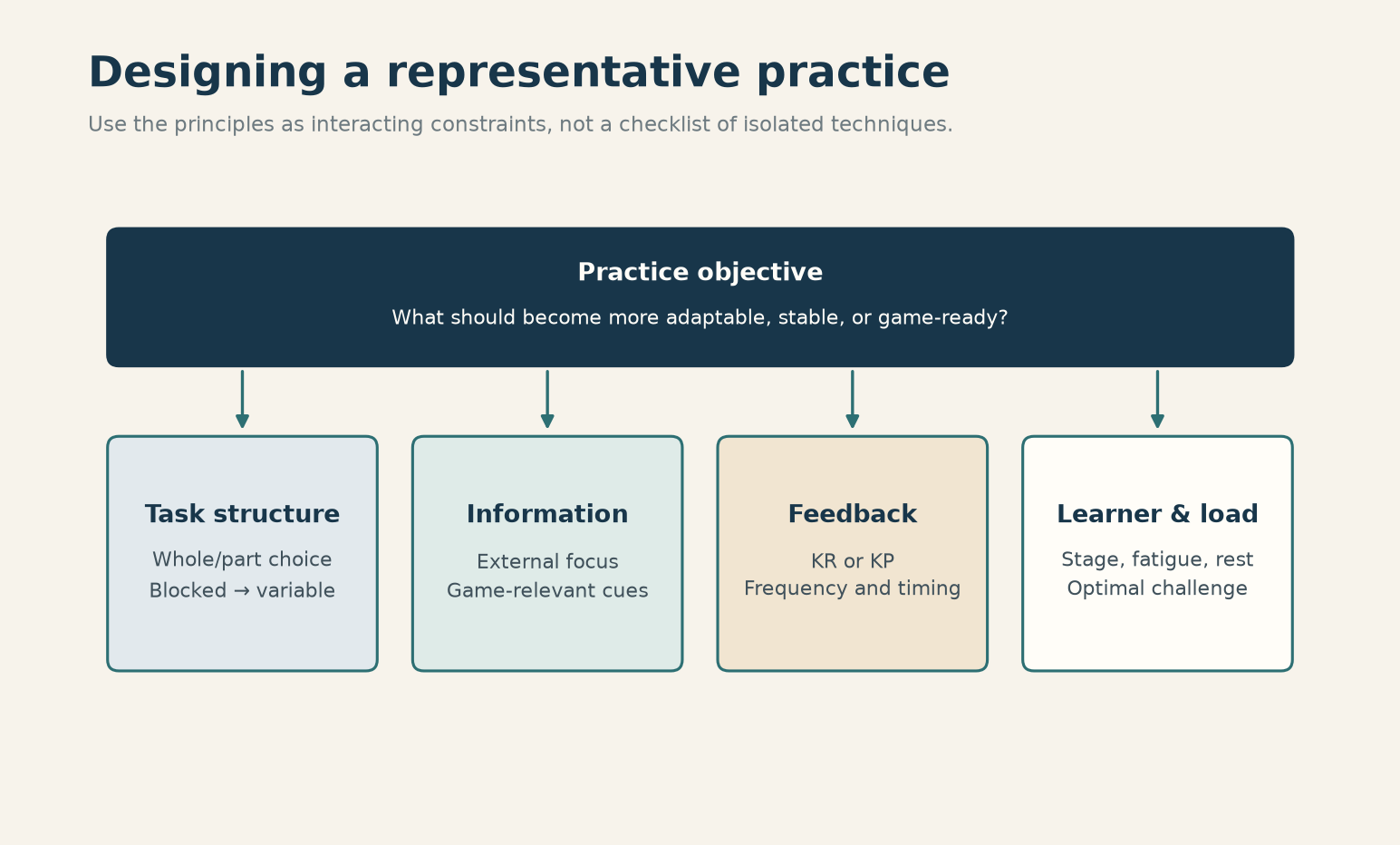
A well-designed shooting practice might incorporate several principles:
- Encoding specificity and representative design (Principles #1 and #10): Finish from a moving pass with a recovering defender and a goalkeeper.
- Practice variability (Principle #2): Vary the pass origin and shooting angle after players establish the task goal.
- External focus (Principle #4): One cue about the target, such as “drive the ball to the bottom corner.”
- Feedback frequency (Principle #6): Observe a short set before giving one summary statement.
- Distribution (Principle #8): Insert recovery when fatigue degrades the intended action.
- Learning stage (Principle #9): Run the same objective at different difficulty levels for different players.
- Observation (Principle #11): Show one representative example and direct attention to one useful feature.
- Optimal challenge (Principle #12): Adjust space and pressure so errors remain informative.
Select the principles that address the current learning problem. Applying all 12 at once would make the task difficult to interpret and revise.
Conclusion
Motor learning research offers coaches a disciplined way to design, observe, and revise practice. The central question is not whether a drill looks busy or produces immediate success. It is whether the learner can retain the capability and adapt it to a meaningful new situation. The evidence behind these 12 principles varies in strength: some rest on decades of replicated findings, and others, such as the size of attentional focus and feedback frequency effects, are being revised as better-powered studies and bias-corrected analyses appear. The principles are therefore best treated as hypotheses for practice design, with retention, transfer, and the learner’s response as the test.
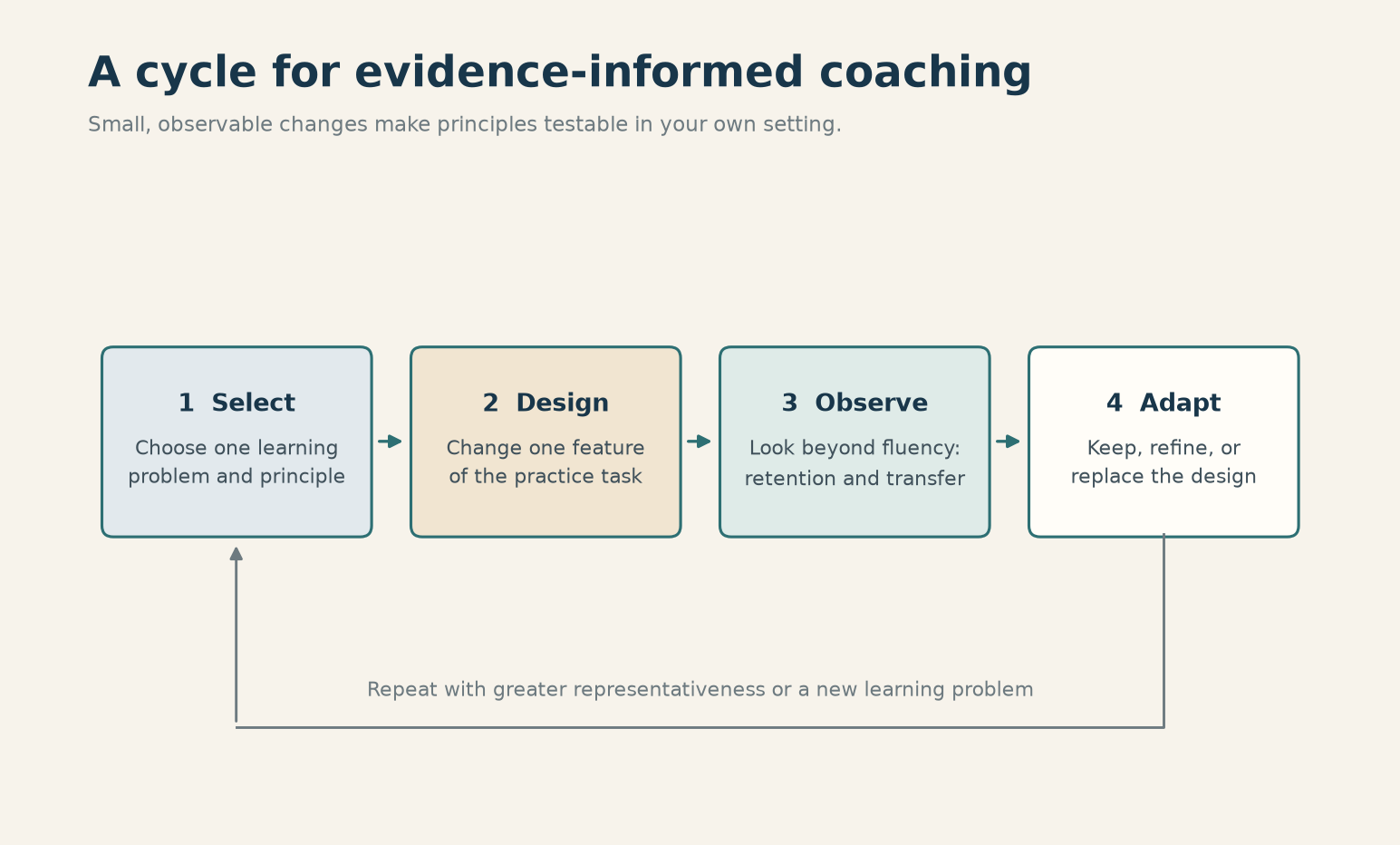
- Identify one recurring learning problem, such as a skill that succeeds in a drill but disappears in a game.
- Choose one principle that directly addresses that problem.
- Change one practice feature while keeping the objective stable.
- Observe a delayed retention or transfer task, not only the immediate practice result.
- Retain, revise, or remove the change based on that evidence.
Design Your Own Drill: A Student Exercise
Reading about a principle is not the same as being able to apply it under the constraints of a real practice session. This exercise is intended for coaching and kinesiology students who want to practice the underlying skill of this article: turning a motor learning principle into a defensible drill design, rather than memorizing the principle’s name. The drill appendix (PDF) holds worked examples of the same process: 60 drills, five per principle, with diagrams for printing.
- Name the learning problem. State what the player currently cannot do, or cannot do reliably under game-like conditions. Write it as a short coaching scenario.
- Choose the principle that targets it. Pick the single principle from this article whose practice-design question (see the Quick Reference Guide) most directly addresses the problem, and write the section objective in your own words.
- Design the practice task. Use the drill format from this article: link to the objective, setup, how it runs, how to make it easier or harder, and the coach’s role. State what you are holding constant and what you are changing relative to a baseline drill.
- Predict the retention or transfer test. Decide, before running the drill, how you will know whether learning occurred rather than only performance. Specify a delayed retention test, a transfer test under a new context, or both.
When you design your own drill, resist the temptation to stop at step 3. A drill that looks sound on paper only demonstrates performance; naming the retention or transfer test in step 4 is what connects the design back to the performance-versus-learning distinction introduced at the start of this article.
Start with one learning problem and one defensible change. A principle earns its place in practice when it helps explain what the learner needs, produces a task that can be evaluated, and survives a retention or transfer test.
References
Image Credits
All editorial illustrations were generated with OpenAI image generation using the shared visual specification documented in blog/STYLE.md. Conceptual diagrams were produced reproducibly in Python with Matplotlib and represent explanatory models rather than empirical datasets.
Test Your Knowledge
Test your understanding of the motor learning principles covered in this article with this interactive quiz. Select your answer for each question and continue through all 17 questions. Your results will be shown at the end, where you can review which answers were correct or incorrect. Hints are provided with each question to guide your thinking!
Citation
@online{furtado2025,
  author = {Furtado, Ovande},
  title = {Applying {Motor} {Learning} {Principles} in {Youth} {Soccer}
    {Coaching}},
  date = {2025-05-20},
  url = {https://drfurtado.github.io/site/blog/posts/mlp/},
  langid = {en}
}