Chapter 14: Demonstration and Verbal Instructions
1 Objectives
After completing this chapter, you will be able to:
- Describe what an observer perceives from a skilled demonstration of a motor skill and procedures researchers have used to arrive at this conclusion
- Discuss the influence of beginners observing other beginners as they practice a skill
- Identify the main features of the two predominant theories about how observing a demonstration helps a person learn a motor skill
- Give examples of how instructions can influence where a person directs his or her attention when performing a motor skill
- Define verbal cues and give examples of how they can be used in skill learning or relearning situations
2 Prepare
2.1 Read the textbook chapter
It is imperative that you read the textbook chapter (Magill and Anderson 2024) before watching the video lectures. The textbook provides a comprehensive and detailed explanation of the concepts, theories, and research findings related to demonstration and verbal instructions. The video lectures will build on this foundation and provide additional insights and examples.
2.2 Chapter Summary
Demonstration is undoubtedly the most common means of communicating how to perform a motor skill. A golf instructor demonstrates a putt, a dance teacher models a step sequence, a physical therapist shows a patient how to transfer from a bed to a wheelchair—each relies on the same basic assumption: that watching someone perform a skill provides the most helpful information in the least amount of time (Magill and Anderson 2024). Yet research has made clear that this assumption is not universally true. The effectiveness of demonstration depends on what the learner’s brain actually perceives, the type of skill being learned, and the instructional context. Similarly, verbal instructions and cues—the second most common instructional strategy—carry their own conditions for effectiveness. This chapter unpacks the science behind both (Magill and Anderson 2024).
2.2.1 What the Observer Perceives from a Demonstration
2.2.1.1 The Visual Perception of Motion
When a learner watches a demonstration, the brain does not simply register “limbs moving.” Instead, the visual system automatically extracts the invariant relative motions that characterize the skill’s coordination pattern—the ratio of timing between body parts, the coupling between segments, the rhythmic structure of the action (Magill and Anderson 2024). These relationships define what the skill is, regardless of who performs it or at what speed.
Research using the point-light technique confirms this capacity with elegant simplicity. Researchers place LEDs or reflective markers on a performer’s joints, film them in the dark, and show observers only the moving dots. Results are striking (Magill and Anderson 2024):
- People accurately identify walking, running, and throwing from moving dots alone
- Observers can even identify their friends from point-light displays
- Expert badminton players can predict the direction of an opponent’s stroke as accurately from a point-light display as from a full video
The observers are not relying on any single variable like limb velocity; they use the invariant relative time relationship among components—the ratio of the forward and return swing of the lower leg in gait, for example—to identify and categorize the movement pattern (Magill and Anderson 2024). This tells us that the most important information a demonstration needs to provide is the relative motion structure, not surface-level appearance.
2.2.1.2 What Movement Characteristics Change When Learners View a Skilled Demonstration?
If learners use relative motions to perceive movement, skilled demonstrations should produce detectable changes in learners’ relative motion patterns. Schoenfelder-Zohdi (1992) tested this on the slalom ski simulator, a device requiring smooth, rhythmic leg-driven side-to-side movements (Magill and Anderson 2024). Participants who observed a skilled demonstration before practice developed coordinated movement patterns significantly earlier during practice than those who received only verbal instruction about the task goal. A subsequent meta-analysis of 64 studies confirmed that demonstrations reliably convey the relative motions needed to approximate a model’s coordination pattern (Magill and Anderson 2024).
Researchers have also shown that learners do not necessarily need to observe the model’s full body to pick up the critical coordination information. Horn et al. (2005) found that point-light displays were as effective as full-body videos for producing changes in relative motion during a soccer chipping task (Magill and Anderson 2024). And Hodges et al. (2005) showed that observing only the toe of a skilled kicker produced better hip-knee coordination in the learner than observing the whole leg or the foot—the minimal, distal information was more informative than the full display.
2.2.1.3 The Influence of Skill Characteristics
Not all skills benefit equally from demonstration. The most important determinant of whether demonstration will be effective is whether the skill requires the acquisition of a new pattern of coordination (Magill and Anderson 2024).
| Type of Skill | Demonstration’s Impact |
|---|---|
| Requires learning a new coordination pattern (e.g., slalom skiing for the first time) | Highly effective—demonstration provides the coordination blueprint |
| Requires learning new parameters for a well-learned pattern (e.g., hitting a tennis ball harder) | Less effective—the learner already has the coordination pattern; only parameters need updating |
This distinction explains why research findings on demonstration have been inconsistent: different studies used different types of tasks, some requiring new coordination and others requiring only parameter adjustment (Magill and Anderson 2024).
2.2.1.4 The Neural Basis for Observational Learning: Mirror Neurons
The behavioral benefits of observation have a neurological foundation. In the early 1990s, Rizzolatti and colleagues discovered neurons in the monkey premotor cortex that fired both when the monkey performed a goal-directed action and when it watched another perform the same action (Magill and Anderson 2024). These mirror neurons create a functional link between perception and action.
Evidence for a human mirror neuron system comes from multiple methods (Magill and Anderson 2024):
- fMRI studies show activation in the inferior frontal gyrus (IFG) during observation, including Broca’s area and the supplementary motor area (SMA)
- EEG recordings confirm mirror-like neural activity during action observation
- TMS (transcranial magnetic stimulation) disrupts automatic imitation of observed movements—establishing a causal link between this mirror system and observational learning
The clinical implication is significant: stroke patients who observe healthy individuals perform goal-directed arm movements show improvements in their own motor function, and this “action observation therapy” is enhanced when combined with regular physical therapy (Magill and Anderson 2024).
2.2.1.5 Observing Skilled Demonstrations
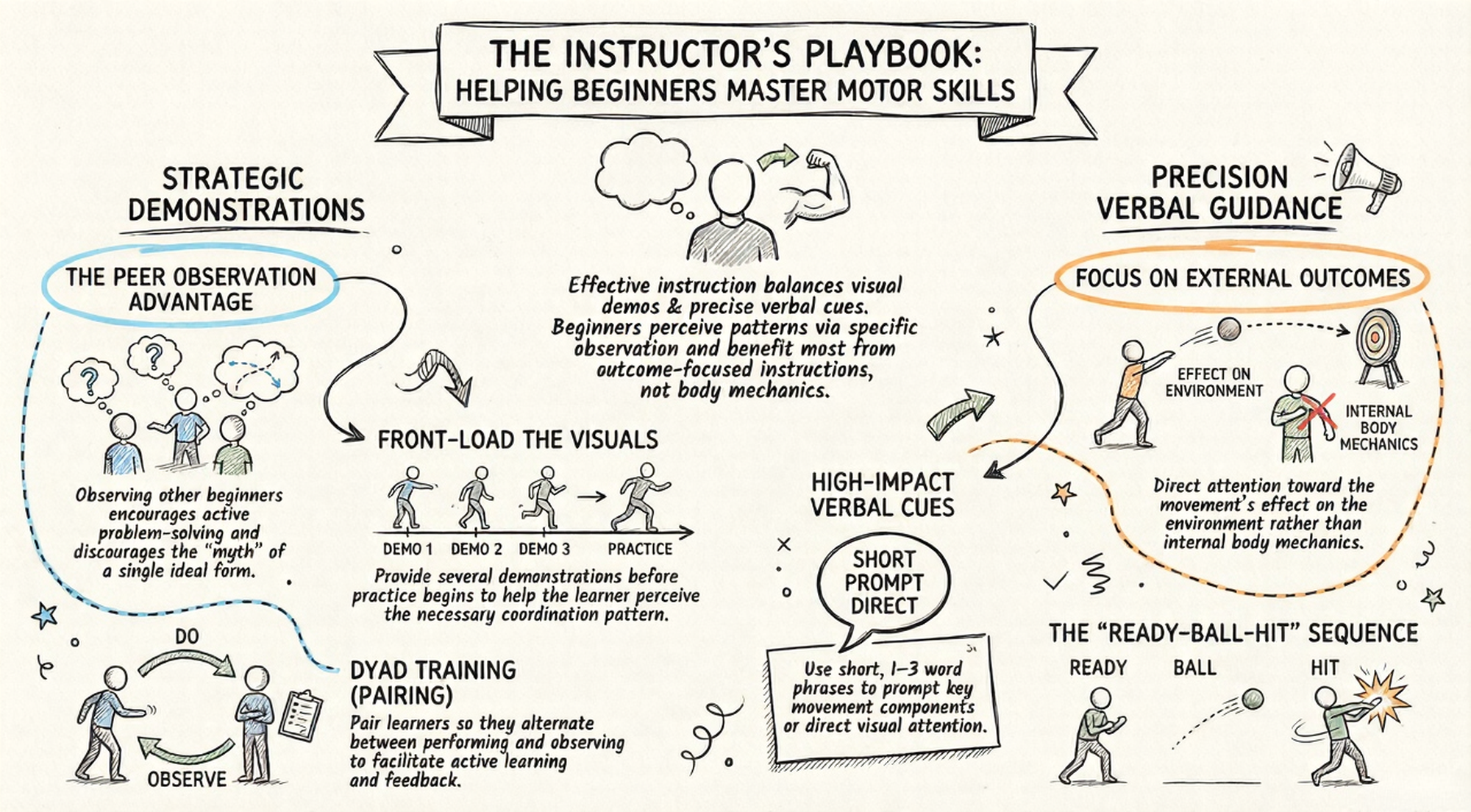
Two reasons support the value of skilled, accurate demonstrations. First, a high-quality demonstration provides high-quality invariant motion information for the observer to detect. Second, observation of a skilled model also communicates the strategy used to solve the movement problem, which the learner then tries to adopt on initial practice attempts (Magill and Anderson 2024). Practitioners should demonstrate frequently—especially before practice begins—and continue demonstrating during practice as needed. Research by Weeks and Anderson (2000) showed that several demonstrations before practice, or a “combination” schedule of multiple pre-practice and mid-practice demonstrations, produced better skill learning than interspersed single-demonstration trials (Magill and Anderson 2024).
2.2.2 Novices Observing Other Novices Practice
Although theory and evidence favor watching skilled models, research consistently shows that beginners who observe other beginners practice will perform at a higher level when they begin practice than the beginners they observed (Magill and Anderson 2024). This counterintuitive finding reflects the power of active problem solving. Instead of imitating a perfect performance, the observer is required to:
- Observe mistakes: see what not to do, understanding the boundaries of the correct movement pattern
- Process feedback: hear the instructor’s commentary in context—connecting correction to the specific error just witnessed
- Watch corrections: see how a fellow learner incorporates feedback across successive attempts, gaining insight into the error-correction process itself
One practical implementation is dyad practice: pairs of students alternate roles, one performing while the other observes. When instructors provide verbal feedback to the performer—and observers use a checklist of key skill elements to guide their watching—learning is facilitated for both members of the pair (Magill and Anderson 2024). This approach engages the observer in goal-directed attentional activity rather than passive watching.
2.2.3 How the Observing of Demonstrations Influences Learning
Two prominent theories propose different accounts of why watching a demonstration improves motor skill learning. Both have research support, and neither has been proven definitively superior (Magill and Anderson 2024).
2.2.3.1 Cognitive Mediation Theory
Proposed by Bandura (1986) and extended to motor learning, cognitive mediation theory holds that when a learner observes a model, they translate the movement information into a symbolic memory code stored in memory (Magill and Anderson 2024). This stored representation serves both as a blueprint for executing the skill and as a standard for detecting and correcting errors.
Four subprocesses govern this sequence (Magill and Anderson 2024):
- Attention process: the learner must selectively attend to the critical features of the demonstration. Divided attention during observation—as when performing a concurrent secondary task—impairs learning.
- Retention process: symbolic coding, labeling, rehearsal, and organization transform what is observed into a durable memory representation.
- Behavior reproduction process: the representation is translated back into physical action; success requires sufficient physical capability.
- Motivation process: incentive must exist to perform the observed action; without it, the sequence terminates before execution.
Research supports each subprocess. For example, Smyth and Pendleton (1990) showed that preventing movement rehearsal in the interval between observation and recall reduced the number of movements remembered (Magill and Anderson 2024).
2.2.3.2 Dynamic View of Modeling
Proposed by Scully and Newell (1985) and grounded in Gibson’s theory of direct perception, the dynamic view of modeling rejects the need for a symbolic coding step (Magill and Anderson 2024). Instead, it proposes that the visual system automatically detects and picks up the invariant coordination information from a model’s movement, directly constraining the motor control system to act accordingly—without conscious transformation.
On this view, what the learner needs from a demonstration is access to the invariant coordination relationships between body parts. Additional demonstrations then help the learner parameterize the action—setting the appropriate speed, force, and amplitude (Magill and Anderson 2024). The observer need not consciously analyze or store the movement; the visual information itself acts as the constraint.
The dynamic view aligns with the findings from point-light research, which show that observers extract coordination information automatically and without full body visibility (Magill and Anderson 2024).
2.2.4 Verbal Instructions and Attention
2.2.4.1 The Quantity of Instructions
A fundamental constraint on verbal instruction is the learner’s limited attention capacity (Magill and Anderson 2024). Beginners are already dividing attention between remembering instructions and actually performing the skill—too many instructions exceed this capacity and become counterproductive. Practitioners should communicate the minimum amount of information needed to initiate effective practice.
2.2.4.2 Verbal Instructions to Focus Attention on Movement Outcomes
A critical insight from attention research is that instructions work best when they direct focus to the outcomes of movement rather than the movements themselves. This is the core of the action effect hypothesis (Prinz, 1997): actions are best planned and controlled by reference to their intended effects (Magill and Anderson 2024).
Research distinguishes:
- Internal focus of attention: directs the learner to their own body movements (e.g., “focus on pushing the platform after it crosses center”)
- External focus of attention: directs the learner to the intended movement outcome or its effect on an implement (e.g., “focus on the pendulum motion of the club head”)
Research consistently shows that an external focus of attention leads to better motor learning than an internal focus across a wide variety of skills—alpine skiing, golf, basketball, soccer, volleyball, dart throwing, and balance tasks (Magill and Anderson 2024). Wulf and Weigelt (1997) demonstrated this on the ski simulator: detailed instructions about how to move actually led to worse performance and transfer than instructions focusing only on the action goal.
One effective strategy is discovery learning: instructions specify only the action goal, allowing the learner to discover how to move to achieve it. This external-focus approach supports more automatic motor control (Magill and Anderson 2024).
2.2.4.3 Verbal Analogies
Verbal analogies (or metaphoric imagery) are instructions that convey movement outcomes through familiar, relatable images rather than explicit movement rules (Magill and Anderson 2024). Instead of explaining how to impart topspin in table tennis, for example, instructors can tell learners to “swing the bat up the hypotenuse of an imagined right-angled triangle.” Liao and Masters (2001) found that learners given this analogy performed the topspin shot more effectively than those given explicit instructions, especially under pressure or dual-task conditions (Magill and Anderson 2024).
This effectiveness relates to implicit learning: analogies minimize the accumulation of explicit verbal rules, producing motor patterns that are more robust under stress and less susceptible to reinvestment (reverting to conscious movement control when under pressure) (Magill and Anderson 2024).
2.2.4.4 Verbal Instructions to Focus Attention on Invariant Environmental Context Regulatory Conditions
For open skills, an important instructional goal is directing learners’ attention to the relevant environmental cues (regulatory conditions) that shape the required movements. Remarkably, research shows that learners can detect and use these cues without conscious awareness (Magill and Anderson 2024).
Magill (1998) demonstrated this with a pursuit-tracking task: participants steadily improved tracking on a repeated cursor pathway segment without ever realizing it repeated. Crucially, explicit instructions about rare but relevant environmental features can actually impair performance: learners directing attention to a low-frequency rule consume attentional resources better devoted to the task itself (Green & Flowers, 1991) (Magill and Anderson 2024). Varied practice in multiple contexts is the most reliable way to develop sensitivity to regulatory environmental conditions.
2.2.4.5 Verbal Instructions Influence Goal Achievement Strategies: Speed-Accuracy Skill Instructions
Instructions also shape the strategy a learner adopts for speed-accuracy skills. Blais (1991) showed that participants told to emphasize accuracy on a serial pursuit-tracking task ultimately achieved the best combined speed-accuracy performance (Magill and Anderson 2024). This aligns with motor program and dynamical systems theories: the invariant movement pattern (accuracy component) should be established first, and the speed parameter increased as practice progresses.
2.2.5 Verbal Cues
Verbal cues are short, concise phrases that serve two distinct purposes: (1) directing the performer’s attention to regulatory conditions in the environmental context, and (2) prompting key movement components of skills (Magill and Anderson 2024). Unlike extended verbal instructions, their brevity keeps them within attention capacity limits and allows cue-action associations to become automatic with practice.
2.2.5.1 Verbal Cues and Demonstrations
Combining verbal cues with demonstrations enhances both. Janelle et al. (2003) found that non-soccer players who observed a skilled model video with accompanying auditory verbal cues and visual arrow cues learned an accuracy pass with better form and outcome accuracy than five other practice conditions, including demonstration alone (Magill and Anderson 2024). The cues directed attention precisely to the critical features highlighted in the video.
2.2.5.2 Verbal Cues That Focus Attention While Performing
Cues delivered just before or during a movement guide attention to the critical element in the moment. Masser (1993) had first-grade students practice headstands; just before each attempt, the instructor said “Shoulders over your knuckles.” Three months later, cued students maintained the skill, while non-cued students performed poorly (Magill and Anderson 2024). The same result occurred for learning the forward roll.
2.2.5.3 Verbal Cues as Prompts
Learners can use verbal cues to prompt their own performance through self-cueing. Cutton and Landin (1994) taught beginning tennis students five cues to say aloud on each trial: “ready,” “ball,” “turn,” “hit,” and “head down” (Magill and Anderson 2024). Students who self-cued learned groundstrokes better than those who received only instructor feedback, because the cues directed attention to the critical elements of each stroke.
2.2.5.4 Verbal Cues Aid Skilled Performance
Verbal cues also benefit those who are already skilled. Landin and Hebert (1999) had university varsity tennis players self-cue “split” (balanced two-foot stop), “turn” (shoulders and hips to ball), and “hit” (track ball to racquet contact) during volley practice over five weeks (Magill and Anderson 2024). Players showed marked improvements in both performance and technique, confirming that the attention-directing function of cues remains valuable well beyond the beginner stage.
2.2.5.5 The Purposes of Verbal Cues
The two functions of verbal cues—directing attention and prompting action—are not mutually exclusive. With practice, cue-action associations become automatic, allowing the performer to use cues without consuming excess attentional capacity and freeing resources for the perceptual and motor demands of the skill itself (Magill and Anderson 2024).
2.3 Your Key Takeaways for Smarter Learning
Understanding the science of demonstration and verbal instruction equips both practitioners and learners with more effective strategies. Here are the essential principles:
- Demonstrate frequently and before practice. Several prepractice demonstrations give learners the coordination blueprint they need; continue demonstrating during practice as needed (Magill and Anderson 2024).
- Target new coordination patterns. Demonstration is most powerful when learners must acquire a new movement coordination pattern—not when they simply need to scale an existing one (Magill and Anderson 2024).
- Use beginners as learning models. Pairing beginners so one practices while the other observes—with instructor feedback to the performer—facilitates learning for both, leveraging active problem solving (Magill and Anderson 2024).
- Direct attention externally. Instructions that focus learners on the intended outcome or effect of movement—not on the movements themselves—consistently produce better learning (Magill and Anderson 2024).
- Keep instructions minimal. Beginners cannot attend to many instructions at once. Prioritize the most critical information and resist the temptation to over-explain (Magill and Anderson 2024).
- Use verbal cues. Short, precise cues—delivered by the instructor or self-generated—direct attention efficiently and strengthen cue-action associations through practice (Magill and Anderson 2024).
- Trust implicit learning. For open-skill regulatory conditions, allow varied practice to build sensitivity to environmental cues; explicit naming of rare features can hinder rather than help (Magill and Anderson 2024).
3 Practice
Tip: These videos are fast-paced. If you need more time to absorb the content, slow down the playback speed using the settings (⚙) menu in the video player.
3.1 Objective 1: What the Observer Perceives from a Demonstration
Describe what an observer perceives from a skilled demonstration of a motor skill and procedures researchers have used to arrive at this conclusion.
3.2 Objective 2: Beginners Observing Other Beginners
Discuss the influence of beginners observing other beginners as they practice a skill.
3.3 Objective 3: Two Theories of How Demonstration Influences Learning
Identify the main features of the two predominant theories about how observing a demonstration helps a person learn a motor skill.
3.4 Objective 4: How Instructions Influence Attention
Give examples of how instructions can influence where a person directs his or her attention when performing a motor skill.
3.5 Objective 5: Verbal Cues
Define verbal cues and give examples of how they can be used in skill learning or relearning situations.
3.6 Frequently Asked Questions
The observer perceives invariant relative motions—the timing relationships and coordination patterns among body segments that define a skill. The brain does not simply record what limbs look like; it automatically extracts the underlying movement structure.
It is a research procedure in which lights or reflective markers are placed on a person’s joints, and only those moving dots are filmed in the dark. Observers can accurately identify actions like walking, running, or throwing from dot patterns alone—confirming that movement recognition relies on relative motion information, not appearance.
Demonstration is most effective when the learner must acquire a new pattern of coordination (e.g., learning to ski or swing for the first time). It is less effective when the learner already has the coordination pattern and only needs to adjust parameters like speed or force.
Mirror neurons are specialized brain cells that fire both when you perform an action and when you observe someone else perform the same action. Evidence for a human mirror neuron system comes from fMRI studies showing activation in the inferior frontal gyrus (IFG) and supplementary motor area (SMA) during action observation.
Watching a fellow beginner forces active problem solving: the observer sees errors, hears instructor feedback in context, and watches the model attempt to correct mistakes. This engages higher-level cognitive processing than passive expert imitation and consistently produces better subsequent performance.
Proposed by Bandura, cognitive mediation theory holds that observation is translated into a symbolic memory code stored in the brain. This representation serves as a blueprint for performing the skill and as a standard for error detection and correction. Four key subprocesses are involved: attention, retention, behavior reproduction, and motivation.
Proposed by Scully and Newell, the dynamic view argues that no symbolic coding step is needed. The visual system directly detects the invariant coordination information in a model’s movement and constrains the motor system to act accordingly.
Internal focus directs attention to the body movements themselves (e.g., “push your knees outward”). External focus directs attention to the intended movement outcome or effect on an object (e.g., “guide the club head along the arc”). Research consistently shows external focus leads to better learning.
Implicit learning is the acquisition of skill without conscious awareness of what is being learned. Research shows learners can detect and use relevant environmental regulatory cues implicitly—and that explicit instructions about those cues can actually hinder performance by consuming attention.
Verbal cues are short, concise phrases that either direct attention to important environmental features or prompt key movement components. Examples: “Look at the ball” (attention), “Bend your knee” (movement prompt). They work because repeated use builds automatic cue-action associations that reduce attentional demands.
4 Practitioner Toolbox
4.1 Infographics
5 Perform
All graded assignments for this chapter are available in Canvas. Log in to Canvas to complete and submit your work.